Affective AI explained · Updated July 2026
A robot can recognize cues and perform emotion without proving that it feels
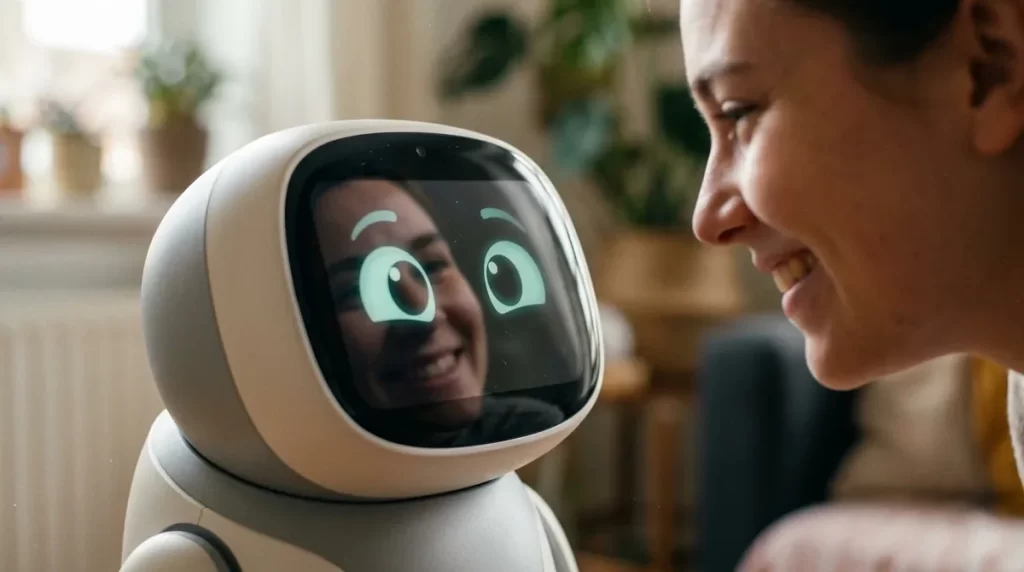
Companion robots may classify a smile, notice vocal energy, remember an interaction and choose a sympathetic response. Those engineering capabilities are not evidence of an inner emotional experience.
Three questions people often combine
Can it detect emotional cues?
Sometimes. A model may classify patterns in face, voice, words, posture or interaction history, usually with uncertainty and context limits.
Technical question
Can it express emotion?
Yes. Designers can coordinate eyes, motion, voice, lights, timing and language to communicate a readable emotional state.
Design question
Does it feel emotion?
Current behavior does not establish a private subjective experience. Convincing performance alone cannot answer consciousness or sentience.
Scientific and philosophical question
A product page may use words such as empathy, mood or personality for all three. A trustworthy explanation should state exactly which capability is implemented and how it was evaluated.
How emotional AI in a companion robot works
- SenseCameras, microphones, touch sensors or app events capture observable signals.
- ExtractSoftware converts them into features such as facial movement, speech rhythm, word patterns or contact duration.
- EstimateA model predicts a label, dimension or probability—for example, positive versus negative valence or high versus low arousal.
- Add contextTime, user preferences, recent events and the current activity can modify the estimate.
- Select behaviorRules or another model choose words, movements, sounds or an escalation.
- Learn from feedbackExplicit correction or interaction history may personalize later responses.
What signals can a robot use?
| Signal | What a model observes | What it cannot safely assume |
|---|---|---|
| Face | Muscle movement, gaze, head pose and temporal changes | That one facial configuration maps reliably to one inner emotion |
| Voice | Pitch, intensity, tempo, pauses and spectral features | That accent, disability, fatigue or speaking style equals a mood |
| Language | Words, sentiment, topics and conversational context | That sarcasm, politeness, quotation or indirect speech is literal feeling |
| Body | Posture, gesture, speed, distance and orientation | That culture, pain, mobility or sensory regulation has one meaning |
| Touch and use | Contact, frequency, timing, ignored prompts and routines | That reduced interaction proves sadness, anger or disengagement |
| Physiology | Heart rate, skin conductance or other wearable data | That arousal identifies a specific emotion or medical condition |
A multimodal system can combine clues, but more sensors do not automatically create truth. They can also create a larger privacy footprint and more ways to be wrong.
Why emotion inference fails
A major scientific review concluded that stereotyped facial configurations are not reliable or specific enough to diagnose a person’s emotional state across everyday contexts. The European Union’s AI Act likewise notes limited reliability, specificity and generalizability.
Context
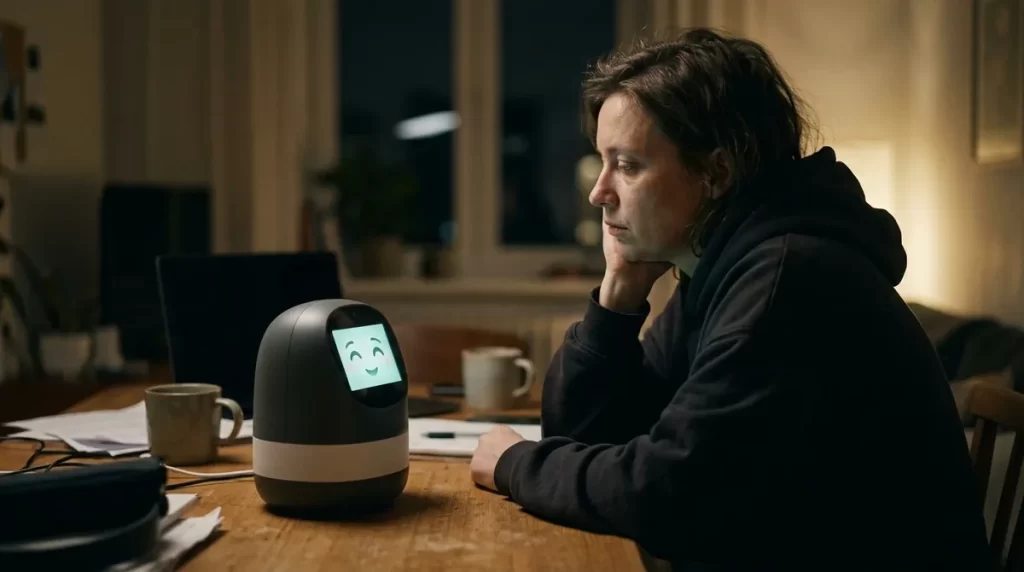
Tears can reflect grief, relief, pain, laughter or irritation. A sensor sees movement, not the full situation.
Individual variation
People differ in expression, speech, movement, masking and comfort with eye contact.
Culture and language
Meaning, display rules, tone and conversational style vary across communities and contexts.
Training labels
Datasets often rely on acted expressions, forced-choice labels or annotator assumptions.
Environment
Lighting, camera angle, noise, multiple speakers and poor connectivity degrade input quality.
Automation bias
Users may trust a confident label even when the model has weak evidence or is outside its intended setting.
The facial-expression evidence review recommends studying expressions in varied real-life contexts rather than treating a small set of posed faces as universal diagnostic markers.
How robots express emotion
Expression is usually the more reliable half of emotional interaction because designers control the output. The goal is not to recreate a human face perfectly, but to make the robot’s state legible without deception.
Motion
Speed, posture, approach, retreat, bounce and stillness can communicate energy or hesitation.
Gaze and eyes
Direction, blinking, pupil graphics and eyelid shape guide attention and social timing.
Voice and sound
Prosody, volume, pauses and nonverbal sounds shape the perceived attitude of a response.
Light and color
Simple status lighting can express availability or urgency, but it needs a non-color alternative.
Language
Acknowledgment and reflective wording may sound caring when they match context and avoid false certainty.
Timing
Interruptions, response delay and turn-taking often matter as much as the content itself.
Can a robot be empathetic?
In human-robot interaction research, empathy is often defined functionally: recognize something about a person’s situation and produce a response that the person perceives as appropriate. That is different from claiming the robot shares the feeling.
A systematic review of empathy in human-robot interaction emphasizes domain, multimodal information and the characteristics of both user and robot. There is no single “empathy module” that works equally for everyone.
Can a companion robot actually feel?
There is currently no accepted test showing that a commercial companion robot has subjective emotional experience. Internal variables called mood, reward, fear or attachment can organize behavior, but naming a variable does not make it a felt state.
Behavior can demonstrate capability, not private experience
A robot that retreats after a loud sound may be executing a safety rule. One that asks for attention may be following an engagement policy. One that remembers a user may personalize a model. All can be meaningful interactions without proving consciousness.
The responsible position is neither “robots can never feel” nor “convincing behavior proves they do.” It is to describe the implemented mechanisms, acknowledge what remains unknown and avoid selling speculation as fact.
Principles for safer emotional interaction
Ask, do not declare
“You seem quieter than usual—am I reading that correctly?” is safer than “You are depressed.”
Show uncertainty
Use confidence thresholds, neutral fallbacks and an easy correction path.
Minimize data
Process locally where practical and avoid retaining raw audio, video or physiological data without need.
Let users opt out
Emotion-related sensing should have understandable controls, not a buried all-or-nothing account setting.
Avoid high-stakes automation
Do not let an inferred mood determine discipline, grades, care access, insurance or emergency conclusions.
Plan escalation
For crisis language or safety concerns, use a tested human-support path and disclose its limits.
Regulation and high-risk contexts
The EU AI Act prohibits AI systems used to infer emotions in workplaces and educational institutions, except for medical or safety reasons. Other uses of biometric emotion recognition can trigger additional high-risk and transparency obligations.
This is a strong warning against using a companion robot as an invisible mood monitor for employees or students. Laws vary by location and application, so organizations need current legal and privacy review rather than relying on a vendor’s description.
Questions before buying an “emotional AI” robot
Our review standard
We will not describe a robot as emotionally intelligent merely because it has animated eyes or generates sympathetic text. Reviews must separate sensors, model claims, expressive design, privacy and demonstrated outcomes.
Frequently asked questions
Do AI companion robots have real emotions?
There is no accepted evidence that current commercial companion robots have subjective emotional experience. They can model internal states and produce convincing emotional behavior.
Can a robot tell when I am sad?
It may estimate sadness from voice, words, face or behavior, but the result can be wrong. A responsible system asks for confirmation and avoids diagnosis.
Is facial emotion recognition accurate?
Performance varies by dataset and task. Scientific reviews warn that facial movements alone are not reliable, specific diagnostic markers for inner emotion across real-world contexts.
Why do people become attached to robots?
Embodiment, responsiveness, memory, routine and human social interpretation can create meaningful attachment even when the robot’s behavior is computational.
Can emotional AI replace a therapist?
No. A robot may support a structured activity, but it cannot be assumed to provide professional assessment, confidentiality, treatment or crisis judgment.
Is emotion recognition legal?
It depends on jurisdiction and use. The EU AI Act prohibits certain workplace and education uses and regulates other biometric emotion-recognition deployments.
How this guide was prepared
We separated detection, expression, empathy and subjective feeling; reviewed scientific evidence on facial inference and social robots; and checked the current text of the EU AI Act. Unsupported accuracy percentages and consciousness claims from the old draft were removed.
- Review: challenges to inferring emotion from facial movements
- Systematic review: empathy in human-robot interaction
- Systematic review of randomized social-robot health interventions
- 2026 meta-analysis of human-agent versus human-human interaction
- European Union Artificial Intelligence Act
- NIST AI Risk Management Framework resources