Social connection guide · Evidence checked July 13, 2026
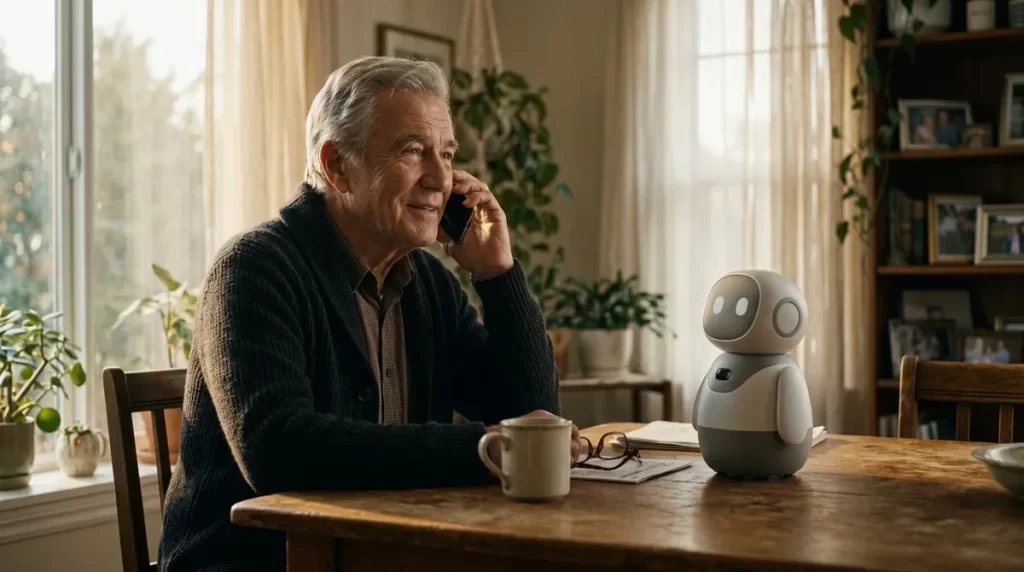
A robot may open a door to connection. It cannot be the whole room.
Robot companions can prompt a call, make a shared activity easier or add a welcome interaction to a quiet day. Research suggests possible loneliness benefits for some older adults, but the evidence is narrow and does not prove that a device can replace friendship, family, community or professional support. The safest goal is connection that extends beyond the robot.
Evidence is promisingMost robot trials remain small, short and older-adult focused
Bridge, not substituteMeasure added human contact and participation
Name the actual gap
Loneliness and social isolation are related, not identical
The World Health Organization defines loneliness as the distressing feeling that arises when the relationships a person has do not match the relationships they want or need. Social isolation is more objective: too few roles, relationships or interactions. Someone can live alone without feeling lonely, or feel deeply lonely in a crowded household. Buying a conversational device before identifying the gap risks solving the wrong problem.
Who and how often?
The number and variety of relationships, social roles and interactions. A robot may prompt contact, but it does not enlarge the network by itself.
Useful measureCalls, visits, group attendance and recurring roles
What support is exchanged?
Practical help, emotional support, advice, companionship and opportunities to help others. Reciprocal contribution can matter as much as receiving attention.
Useful measureSupport requested, received and given
How does connection feel?
Warm, trusting and satisfying relationships differ from strained or unsafe contact. More interactions are not automatically better interactions.
Useful measureBelonging, trust, enjoyment and conflict
Look for the barrier before choosing the tool
What research supports
Possible benefit in older adults, with important limits
A 2026 meta-analysis combined 16 studies with 781 older adults and found that artificial agents were associated with lower loneliness than comparison conditions. Physical social robots showed larger effects than app- or web-based agents, and animal-shaped agents larger effects than humanoid agents. The result is encouraging, but heterogeneity was substantial, settings mattered and the review did not establish a universal prescription.
Promising average effect
Sixteen studies suggested reduced loneliness among older adults. Differences in agent type, setting and session pattern moderated results, and no significant quality-of-life or happiness effect was found.
Long-term-care focus
A meta-analysis examined physical social robots for older residents in long-term-care facilities. That defined population and care context should not be generalized to every age or home.
Long-term evidence still needed
A systematic review of AI applications for older-adult loneliness called for longer-term, culturally competent research that combines quantitative and qualitative outcomes.
| Claim | Evidence position | Main limitation | Responsible wording |
|---|---|---|---|
| A robot can create an enjoyable interaction | Supported as an experience for some users and settings | Preference, novelty and facilitation vary | Test voluntary engagement |
| Social robots can reduce loneliness in older adults | Recent pooled evidence reports a promising average effect | Small body of studies, heterogeneity and narrow populations | Not guaranteed |
| The same result applies to all ages | Not demonstrated | Most research centers on older adults and care environments | Do not generalize |
| A robot is equivalent to a human relationship | Not established and conceptually different | No mutual experience, vulnerability or duty of care | Use as a bridge |
| A robot can end loneliness permanently | No credible evidence supports this promise | Loneliness has personal, relational and structural causes | Avoid it |
A safer job description
Six ways a robot can support connection without impersonating it
Reduce contact friction
Place a chosen person one tap away, display the next scheduled call or offer a user-approved prompt.
Success looks likeMore completed human conversations
Give people something to do together
Use music, photos, games or robot behavior during a family visit, group or care session.
Success looks likeMore reciprocal conversation and enjoyment
Make the next event visible
Remind the user about a library group, faith community, class, volunteer role or peer meeting already selected.
Success looks likeAttendance and repeat participation
Rehearse a bounded interaction
Practice a greeting, question or video-call control before using it with a real person, without calling the robot therapy.
Success looks likeGreater confidence in the real interaction
Add structure around connection
Prompt getting ready, transport timing or a contact plan linked to a social commitment.
Success looks likeFewer missed social opportunities
Surface topics worth sharing
Collect a user-controlled photo, memory or question to bring to the next family call or group.
Success looks likeRicher conversation with people
- asks permission before prompts;
- leads toward people and reciprocal roles;
- supports giving as well as receiving;
- works with a simple backup;
- lets the user stop without guilt.
- claims the robot understands or needs the user;
- encourages disclosure without clear privacy;
- replaces calls, visits or staff time;
- uses attachment to preserve a subscription;
- promises permanent relief.
Match format to the social goal
Conversation, touch and shared activity solve different problems
| Format | Example | Potential bridge role | Does not provide | Key test |
|---|---|---|---|---|
| Conversational stationary service | ElliQ | Proactive routine, activities and family communication features for an older adult | Mutual friendship, emergency response or guaranteed loneliness reduction | Can the intended user hear, answer and reach family successfully? |
| Touch-centered mobile companion | LOVOT | Warmth, gaze, movement and a shared focus during visits | Deep conversation, practical care or broad regional service access | Does touch remain welcome after novelty, cost and maintenance? |
| Therapeutic robotic animal | PARO | Facilitated activity in care settings, especially with older adults | Independent clinical treatment or replacement for staff interaction | Does supervised use improve engagement versus another activity? |
| General consumer robot pet | Loona, AIBO or EMO | Play, hobby communities and a conversation topic with family | A designed loneliness intervention or clinical oversight | Does it create shared activity, or only solitary screen and robot time? |
A four-week social-bridge pilot
Measure whether life expands beyond the device
The pilot should be voluntary, narrow and reversible. Do not demand instant friendship or treat a missed goal as failure. Loneliness often follows loss, illness, exclusion or inaccessible communities; technology cannot assign responsibility for those conditions to the person experiencing them.
- Step 1
Map current connection.
List close ties, regular contacts, groups, places, professional support and opportunities to contribute. Mark which feel supportive and which are missing.
- Step 2
Choose one gap.
Examples: easier family video calls, one recurring community activity, reconnecting with a friend or a shared activity during visits.
- Step 3
Set a human outcome.
Use an observable target such as two completed calls weekly or attending the same group twice, plus a simple quality rating.
- Step 4
Add one robot function.
Enable only the reminder, contact shortcut or activity needed. Minimize sensors and histories unrelated to the goal.
- Step 5
Review at four weeks.
Compare human contact, belonging, burden, privacy, continued interest and what happened on days the robot failed.
Contact
- completed calls or visits;
- group attendance;
- new recurring role.
Support
- help received;
- help or contribution given;
- shared activity.
Experience
- felt understood;
- enjoyment and belonging;
- conflict or pressure.
Burden
- setup and caregiver time;
- subscription and repair;
- privacy or dependency.
Human connection or participation increased, the person still wants the robot and burden is sustainable.
The goal is useful, but prompts, accessibility, timing, contact list or community route needs revision.
Human contact shrinks, distress or pressure appears, privacy is unacceptable or the device does not change the target.
Relational and practical harms
Six ways a companion can make disconnection worse
People visit less
Family or staff may assume the robot has delivered companionship. Protect existing human time in writing.
Performance feels mutual
The robot can generate warmth without experience, vulnerability or responsibility. Explain this honestly.
Service becomes indispensable
Subscriptions, servers and hardware end. Maintain non-robot contact routes and plan a respectful exit.
Private life becomes data
Voice, video, faces, routines and social networks can reveal sensitive information about several people.
The user never wanted it
A gift chosen by family can communicate that a machine is considered enough. Consent and trial access come first.
Budget leaves the community
Hardware and fees may displace transport, hearing support, classes, home visits or other direct connection resources.
Connection often needs infrastructure
Compare the robot with direct human and community options
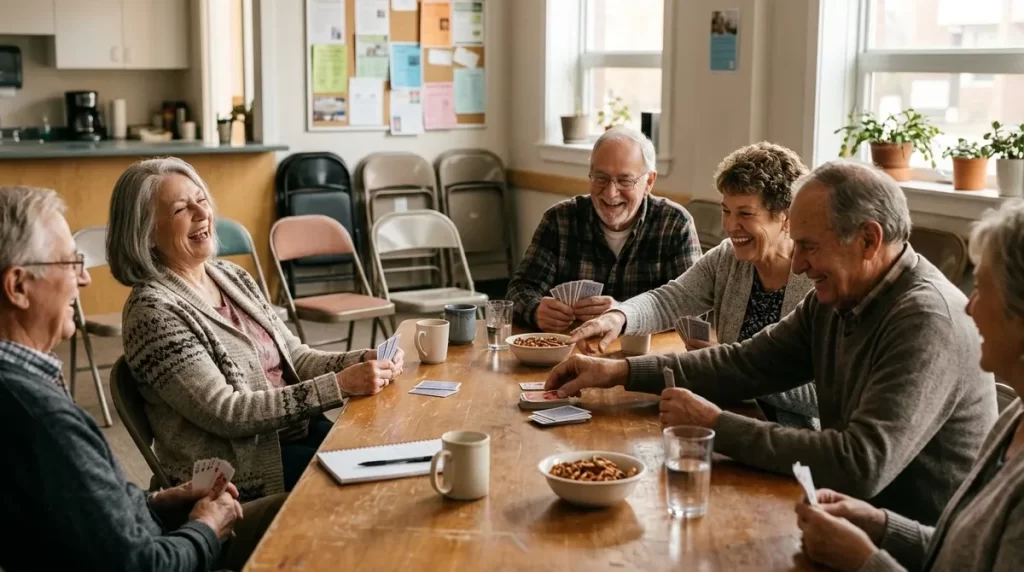
The WHO Commission on Social Connection emphasizes action at individual, relationship, community and policy levels. A device cannot repair inaccessible transport, unsafe neighborhoods, poverty, discrimination or understaffed care. When those are the barrier, spending on the barrier may produce more connection than buying a companion robot.
Scheduled contact
Recurring calls, home visits, peer support, befriending services, mentoring or a walking partner.
Repeated shared activity
Libraries, arts, faith communities, volunteering, exercise, repair groups, games and cultural associations.
Remove the practical barrier
Transport, hearing devices, translation, mobility support, digital training or an accessible venue.
Professional assessment
Primary care or mental-health support when pain, depression, anxiety, grief or cognitive changes contribute.
Link care to local resources
Where available, a trained connector can help identify non-clinical community activities and support.
Simplify the contact route
A photo phone, one-button video call, shared calendar or printed contact plan may be enough.
Print before buying or starting a trial
24-point social connection checklist
Frequently asked questions
Robot companions and loneliness FAQ
Can robot companions reduce loneliness?
They may help some people, particularly in older-adult settings studied to date. Recent pooled evidence is promising, but studies are limited and varied. Benefit is not guaranteed, and a robot should be tested as part of a broader connection plan.
What is the difference between loneliness and social isolation?
Loneliness is a subjective and distressing mismatch between wanted and actual connection. Social isolation is the objective state of having too few roles, relationships or interactions. A person may experience either one without the other.
What is the best robot companion for loneliness?
There is no validated universal ranking. ElliQ emphasizes conversation and older-adult engagement, LOVOT emphasizes touch and presence, PARO is mainly a facilitated care activity, and consumer robot pets emphasize play. The best fit depends on the specific social goal, user preference and service context.
Is a robot better than having no one to talk to?
A welcome robot interaction may be preferable to silence for some people, but that comparison sets the standard too low. The plan should also ask which human, community and access resources can be strengthened and whether the robot helps reach them.
Can a robot provide emotional support?
It can generate responses that feel comforting or help structure an activity. It does not share experience, confidentiality duties or human responsibility. Describe the function precisely and do not imply mutual understanding.
Should I buy a robot for a lonely parent?
Only after the parent freely tries it and identifies a useful goal. First check hearing, vision, speech, internet, privacy, cost and whether transport, calls, visits or community support would address the gap more directly.
When should loneliness be discussed with a professional?
Seek professional support when it persists, causes significant distress, interferes with functioning or accompanies depression, anxiety, cognitive change, substance use or thoughts of self-harm. Urgent safety concerns need human crisis or emergency services.
Bottom line
The best outcome is not attachment to the robot
A companion robot earns a place when it makes human contact, participation or reciprocal contribution easier and the intended user freely values it. It fails when its simulated relationship becomes the destination. Define the social gap, test one bridge function, measure real-world connection and keep community and human care at the center.
Sources and review method
Social-health framing was checked against the WHO social connection Q&A, the 2025 WHO Commission on Social Connection report and the US Surgeon General social connection resources. Robot evidence was interpreted from a 2026 meta-analysis of artificial agents, a 2024 meta-analysis of social robots in long-term care and a 2025 systematic review of AI applications. We prioritize controlled comparisons, population fit, duration, human outcomes and harms over testimonials and manufacturer scores.