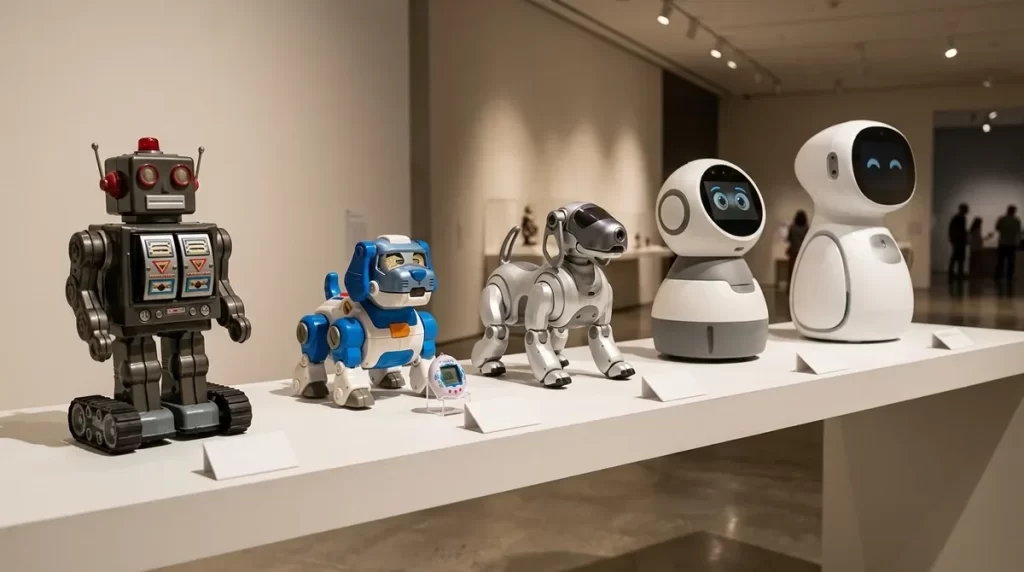
Technology timeline · Updated July 13, 2026
Companion robots did not evolve along one straight path
The modern companion robot combines ideas from conversational software, social robotics, autonomous pets, therapeutic devices and cloud services. Each era solved a different part of the problem—and left important limitations behind.
What does the evolution of robot companion technology mean?
A robot can look sophisticated while depending on a narrow script, and a device with no arms or wheels can still sustain useful interaction. For that reason, progress should not be measured by how human a machine appears. It is better understood as the gradual integration of five layers.
Conversation
From keywords and decision trees to speech recognition, natural-language models and generated responses.
Embodiment
Gaze, posture, movement, sound, warmth and touch make an interaction feel physically present.
Perception
Microphones, cameras, touch sensors, distance sensing and internal telemetry provide context.
Personalization
Names, preferences, routines and interaction history allow behavior to change over time.
Services
Apps, cloud processing, remote care features, subscriptions and software updates extend the hardware.
No single milestone created the companion robot. The category emerged when several of these layers became reliable and affordable enough to put into homes, schools, shops or care settings. Even today, products emphasize different combinations rather than offering every capability equally well.
A concise timeline: from ELIZA to multimodal AI
These milestones show changes in design philosophy as much as improvements in computing. They also explain why today’s market includes seal-shaped therapeutic robots, autonomous dogs, desktop characters and stationary social assistants.
ELIZA demonstrates the social power of conversation
Joseph Weizenbaum’s ELIZA program used pattern matching to imitate a psychotherapist. It did not understand its users, yet people still responded as if the exchange were personal. According to MIT’s account of Weizenbaum’s work, that reaction helped motivate his later warnings about assigning human judgment to computers.
What changed: convincing social response was shown to depend partly on human interpretation, not only machine intelligence.
Therapeutic and social robotics become distinct research fields
Japan’s AIST began developing PARO in 1993, while MIT’s Kismet project explored how an expressive robot could use gaze, facial movement, vocal tone and turn-taking to regulate interaction. Kismet was a research platform, not a household product; PARO followed a specialized path toward care.
What changed: researchers treated nonverbal cues and physical form as functional parts of social interaction.
Sony launches AIBO as a consumer autonomous robot
The original ERS-110 could move, respond to sensors, display behavior and adapt within its designed system. Sony’s May 1999 announcement called it a home entertainment robot and priced it at US$2,500, with a limited initial release.
What changed: autonomous, pet-like robotics moved from laboratories into a recognizable consumer product.
PARO reaches commercial use
After years of research and trials, AIST announced commercialization of the eighth-generation PARO therapeutic robot in 2004. Its seal form, tactile response and calm behavior were designed for social and therapeutic interaction rather than chores. AIST’s release documents that development path.
What changed: companionship became a focused intervention with a defined setting, not merely entertainment.
Pepper brings cloud-connected social robotics into public view
SoftBank and Aldebaran announced Pepper in June 2014 and began sales in Japan in 2015. The platform combined speech, expressive movement, sensors, internet connectivity and installable robot applications. The original SoftBank announcement also described estimates of emotion from facial expression and voice—not direct access to a person’s feelings.
What changed: social robots became programmable, connected platforms used in homes and customer-facing environments.
Modern aibo and LOVOT emphasize relationships over utility
Sony relaunched aibo in 2018 with connected AI features after discontinuing the earlier line in 2006. GROOVE X unveiled LOVOT in December 2018 and launched it in 2019 around warmth, touch, lifelike motion and attachment. GROOVE X’s company history records the unveiling.
What changed: cloud updates, companion apps and ongoing services became central to the ownership experience.
ElliQ expands proactive companionship for older adults
Intuition Robotics’ consumer launch positioned ElliQ as a stationary, voice-first companion that could initiate check-ins, activities and wellness prompts. The company’s ElliQ 2.0 announcement illustrates the shift from waiting for commands to structured, proactive engagement.
What changed: a companion could organize an ongoing service around routines without needing humanoid mobility.
Generative and multimodal models widen interaction
Newer systems can combine speech, images, sensor context and generated language more flexibly than menu-based dialogue. Some existing robots also gain capabilities through software updates. Results remain bounded by the device’s microphones, cameras, processors, network connection, safety rules and vendor integration.
What changed: conversation became less predictable and more context-sensitive, while verification, privacy, latency and hallucination became larger design concerns.
Five eras that shaped modern companion robots
Rules and scripted dialogue
Early conversational programs matched words to prepared response patterns. They proved that people readily attribute intention to language, but their coherence broke when a conversation moved outside the script.
Legacy today: wake phrases, fallback answers and carefully authored interaction flows remain valuable because they are predictable.
Embodied social signals
Kismet and related research treated gaze direction, timing, posture and facial motion as a feedback loop. A robot could signal attention, invite a turn or withdraw without producing a sophisticated sentence.
Legacy today: eye contact, head orientation, animation and sound often determine whether an interaction feels responsive.
Autonomy in consumer hardware
AIBO demonstrated that sensors, locomotion and behavior selection could create an engaging pet-like experience. The engineering challenge expanded beyond AI to motors, balance, battery life, durability and safe movement.
Legacy today: believable behavior depends on the entire physical system, not a language model alone.
Cloud, apps and recurring service
Connected robots gained remote processing, account profiles, mobile controls and over-the-air updates. This made improvement after purchase possible, but also introduced subscriptions, data transfers and dependence on vendor servers.
Legacy today: service continuity and privacy are part of product quality.
Generative, multimodal interaction
Large models can produce more varied language and interpret multiple input types. In a robot, those capabilities must still be connected to identity, memory, sensors and physical actions through a controlled software layer.
Current reality: fluent language is an interface capability, not proof of consciousness, reliability or emotional experience.
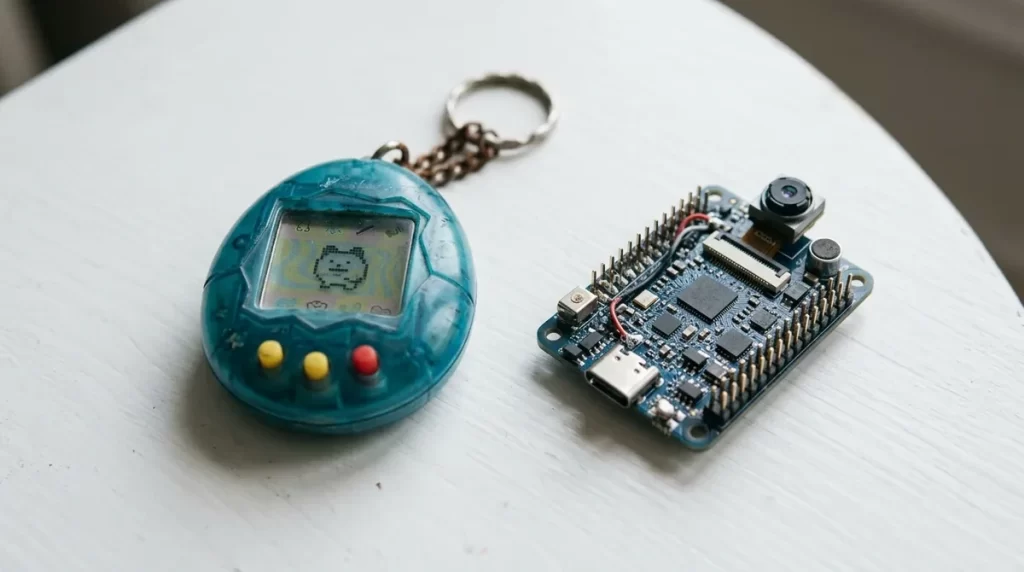
How the companion-robot technology stack changed
The largest improvements are visible when old and current approaches are compared side by side. The final column matters most: every advance creates or retains a practical limit.
| Layer | Earlier approach | Current approach | Persistent limit |
|---|---|---|---|
| Conversation | Keywords, scripts and fixed branches | Speech recognition, intent models and generated language | Fluency can conceal factual error or weak understanding |
| Vision | Simple light, color or object triggers | Face, person, scene and object recognition | Lighting, angles, bias and occlusion reduce reliability |
| Movement | Preprogrammed sequences in controlled spaces | Sensor fusion, mapping and adaptive animation | Stairs, clutter, pets, batteries and wear remain difficult |
| Memory | Short session state or local variables | User profiles, histories, preferences and cloud retrieval | Long memory raises privacy, accuracy and deletion questions |
| Emotion | Fixed expressions linked to events | Behavior estimates from voice, face and interaction patterns | A classification is not a person’s internal emotional state |
| Updates | Capabilities fixed at purchase | Apps, cloud models and over-the-air software | Features may change or disappear when support ends |
| Business model | One-time hardware purchase | Hardware plus subscriptions, content and services | Total cost and long-term access may be uncertain |
Four different paths led to today’s robot companions
The history of the field is easier to understand as parallel design traditions. None is inherently more advanced; each optimizes for a different relationship and environment.
Presence through behavior
AIBO, aibo, LOVOT and desktop characters use motion, sound, touch and recurring habits to encourage playful attachment. Conversation may be secondary.
Success means: the character remains engaging, safe and believable over time.
Calm, structured interaction
PARO represents a specialized path developed around care environments. Evaluation should focus on the intended population, protocol and evidence rather than novelty.
Success means: measurable benefit with appropriate human oversight.
Conversation and routine
Pepper and ElliQ emphasize spoken interaction, information, reminders, activities or proactive prompts. A mobile humanoid body is optional.
Success means: accessible, useful engagement that does not overpromise autonomy.
Testing social mechanisms
Kismet, NAO and other platforms help researchers study attention, teaching, coordination and human response. A laboratory result does not automatically translate to unsupervised home use.
Success means: reproducible insight about a defined question.
What has not evolved as far as marketing may suggest
Simulated emotion is not feeling
A robot can display affection or classify a vocal pattern without possessing subjective experience. The performance may still be meaningful to a user, but the distinction should remain clear.
Conversation is not dependable knowledge
A natural answer can be inaccurate. Health, safety, financial and emergency guidance needs verified sources, constrained workflows or a qualified human.
Recognition is not certainty
Face, voice, mood and activity estimates are probabilistic. They can fail for individual users, accents, disabilities, environments or demographic groups.
Personalization is not human understanding
Remembering a birthday or preferred song can improve interaction. It does not mean the system comprehends a life history, relationship or unspoken need.
Autonomy is bounded
Robots act within mechanical, spatial and software limits. Home clutter, network loss, unexpected contact and battery constraints remain everyday engineering problems.
Attachment does not guarantee benefit
Enjoyment and frequent use are valuable outcomes, but they do not prove reduced loneliness, improved health or therapeutic effectiveness.
Five lessons history offers buyers and designers
-
Start with a narrow purpose.The most durable products do not need to imitate a complete person. A clear role—play, structured engagement, telepresence or reminders—makes capability easier to evaluate.
-
Evaluate the whole body, not only the AI.Microphone quality, motor noise, touch response, charging, heat, repairability and interface accessibility can matter more than an impressive demo answer.
-
Treat cloud continuity as a product feature.Ask what works offline, what requires a subscription, how long support is promised and what happens to the robot and stored data if the service closes.
-
Separate attachment from evidence.A lovable design can be worthwhile without making medical claims. Therapeutic or educational claims should match research on the specific product, population and setting.
-
Expect specialization, not one universal humanoid.The historical record favors many forms: animals, small mobile characters, screens, tabletop devices and research humanoids. Form should follow the relationship and task.
What the current transition actually changes
Generative AI can make interaction less repetitive and allow a companion to handle more phrasings than a fixed dialogue tree. Multimodal models can also connect language with images or other context. That is a substantial interface improvement, but it does not erase the engineering beneath it.
A safe product still needs rules about which observations become memories, which requests can trigger physical actions, when an answer should be refused, how a child or bystander is treated, and what happens when confidence is low. The next stage of evolution will therefore be measured not only by more capable models, but by transparent memory, local processing, reliable behavior, repairable hardware and long-term service commitments.
Frequently asked questions
What was the first robot companion?
There is no single uncontested first because the answer depends on the definition. ELIZA was conversational software rather than a physical robot; Kismet was an embodied research platform; PARO followed a therapeutic path; and Sony’s 1999 AIBO was an influential commercial autonomous robot for the home.
Why is ELIZA included if it was not a robot?
ELIZA exposed a central mechanism of companionship: people can perceive empathy or understanding in patterned language. Physical robots later combined that conversational effect with gaze, movement, touch and presence.
Did Pepper really read emotions?
SoftBank described Pepper as estimating emotion from expressions and voice. Such systems infer categories from observable signals; they do not directly know a person’s internal state, and results can be uncertain or wrong.
How did cloud computing change companion robots?
Cloud services enabled heavier speech processing, shared updates, user accounts, remote features and ongoing content. They also created new privacy risks, subscription costs and dependence on vendor infrastructure.
Are today’s AI companion robots conscious?
There is no established evidence that current commercial companion robots possess subjective awareness or feelings. They generate behavior from software, models, stored context and sensor inputs, even when that behavior feels emotionally convincing.
What is likely to improve next?
Expect more natural multimodal conversation, better on-device processing, improved navigation, clearer memory controls and deeper integration with care or home systems. Progress will vary by product, and safety, cost, battery life and service continuity will remain important constraints.
Primary sources and update policy
This history prioritizes institutional archives and original company announcements for dates and product positioning. Useful starting points include MIT on ELIZA and Joseph Weizenbaum, MIT’s Kismet research, Sony’s 1999 AIBO release, AIST on PARO, SoftBank on Pepper and GROOVE X’s LOVOT history.
Last reviewed: July 13, 2026. This page is updated when a milestone date, product status or technical characterization changes materially.