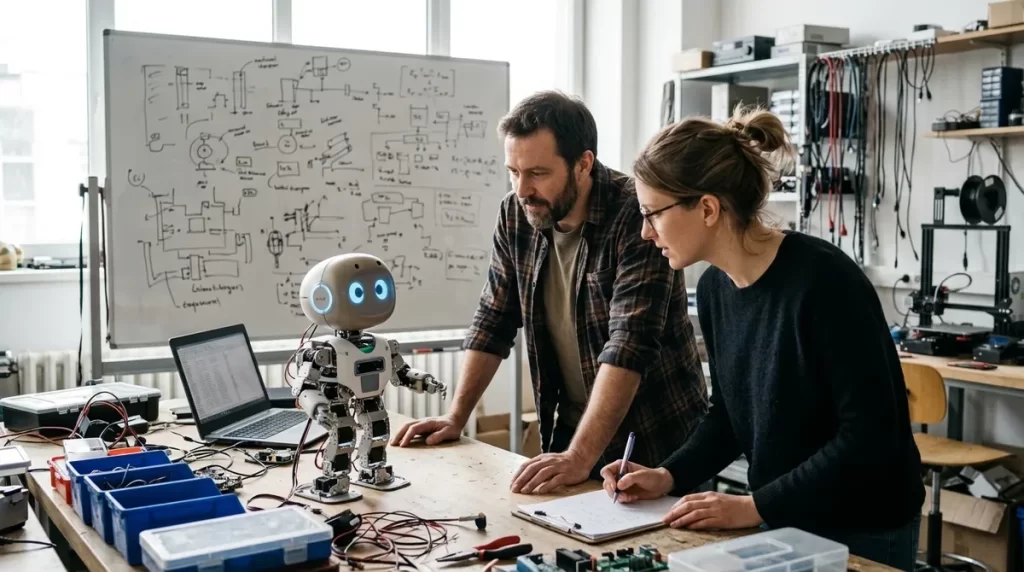
Research perspectives · Sources checked July 13, 2026
What robot companion experts agree on—and where they disagree
The most useful expert insight is not a prediction about human-level empathy. It is a question: what specific human goal can this robot support, under what conditions, with what evidence and what exit plan? This source-based briefing compares five influential research perspectives, one study of robot creators and a new human–robot relationship standard.
13 robot creatorsFindings from a published qualitative interview study
7 practical principlesFrom augmentation and user fit to transparency and exit
How this briefing was built
Expertise is evidence about interpretation, not a substitute for evidence
An expert can explain design constraints, research gaps and ethical consequences better than a marketing page. That does not turn every forecast into a fact. We included a person only when a university or research-lab source verified the identity and field, and when a public source supported the perspective attributed here. We excluded unsourced success percentages, anonymous testimonials and claims of institutional affiliation that could not be corroborated.
Verify the person
Use an official university, laboratory or professional profile rather than a copied biography.
Open the source
Link readers to the paper, institutional article or presentation behind each interpretation.
Name the evidence type
Separate a study, design philosophy, ethical argument, prediction and product claim.
Preserve disagreement
Do not manufacture consensus where researchers emphasize different values or risks.
Check the population
A finding about children, older adults or a laboratory task does not apply automatically to everyone.
Translate cautiously
Turn research into a question a buyer, caregiver or designer can test—not a universal promise.
Five influential lenses
Real researchers ask different questions about companionship
These perspectives are complementary, not rankings. Engineering asks what the system can reliably do. Human–robot interaction asks how people respond over time. Ethics asks who benefits, who bears risk and whether social cues manipulate expectations. Clinical or educational use adds a further requirement: the robot must support a defined human-led goal.
Maja Matarić: augment people instead of automating them away
USC Interaction Lab
Verified perspective
Matarić describes socially assistive robotics as human-centered technology that helps people help themselves. Her lab focuses on machines that provide assistance through social interaction, particularly for people with special needs. The design philosophy is augmentation: the robot supports human ability rather than replacing human work.
This distinction changes the evaluation. A robot does not succeed because it can converse for a long time. It succeeds when a person practices, participates or completes a useful activity more effectively, and when therapists, teachers or caregivers retain responsibility.
Cynthia Breazeal: engagement must serve human flourishing
MIT Personal Robots group
Verified perspective
Breazeal is a pioneer of social robotics and human–robot interaction. Her current work examines long-term life with AI and personified technologies designed to provide personalized support across education, pediatrics, health, wellness and aging. The key design problem is not merely generating a friendly response; it is sustaining useful engagement in everyday life.
Personalization can improve relevance, yet it also expands the data and relationship questions. A system that remembers preferences needs clear controls, representative testing and a benefit that justifies the information collected. Long-term impact matters more than a polished first encounter.
Kate Darling: study the human response to lifelike machines
Social robotics researcher
Verified perspective
Darling’s work examines why people form emotional connections with lifelike machines and what those reactions mean for design and policy. Humans can project intent and life onto autonomous movement even while knowing the device is mechanical. That response can be useful, but it also creates leverage for manufacturers.
The responsible question is not whether the robot truly feels. It is what the design causes people to believe and do. Animal-like motion, gaze, voice and vulnerability can encourage care, disclosure or spending. Product teams should test those effects and avoid using attachment to conceal capability limits, subscription terms or data practices.
Kerstin Dautenhahn: usefulness must be socially acceptable and trustworthy
University of Waterloo SIRRL
Verified perspective
Dautenhahn’s research spans human–robot interaction, social robotics, assistive technology and robot-assisted applications. Waterloo describes companion robots as autonomous systems that can perform useful tasks with or alongside people in a socially acceptable and trustworthy way.
That wording makes social behavior a constraint, not decoration. A technically correct reminder can still fail if the robot interrupts, approaches too closely, ignores cultural expectations or gives users too little control. Trust should follow demonstrated reliability and understandable boundaries; designers should not manufacture more trust than the system deserves.
Sherry Turkle: simulated empathy can change what people accept as care
MIT Initiative on Technology and Self
Verified perspective
Turkle has studied relational artifacts and people’s attachment to technology for decades. Her critical lens asks what is lost when a machine performs concern without experience, vulnerability or responsibility. A soothing interaction may feel helpful in the moment while still changing expectations about reciprocity and human care.
This is not an argument that every robot interaction is harmful. It is a warning against confusing elicited emotion with mutual relationship. The practical safeguard is to evaluate whether the robot supports conversation and care among people or becomes a reason for institutions and families to provide less of them.
Side-by-side interpretation
The same product looks different through each expert lens
| Lens | Primary opportunity | Failure to watch | Evidence that matters | Buyer or designer test |
|---|---|---|---|---|
| Matarić | Motivation and assistance that help a person act | Automating away the human supporter | Functional outcome with appropriate human involvement | What can the user do better? |
| Breazeal | Personalized, engaging support over time | Optimizing novelty or engagement without durable benefit | Longitudinal use, retention and real-world outcome | What remains useful in month three? |
| Darling | Social cues that make interaction intuitive | Attachment used to manipulate trust or spending | Observed human response and distribution of benefit | Who gains from the emotional design? |
| Dautenhahn | Useful action delivered acceptably alongside people | Unpredictable, intrusive or culturally poor behavior | In-context usability, controllability and trust calibration | Can the user understand and refuse it? |
| Turkle | A relational object that can prompt reflection or interaction | Simulation accepted as reciprocal care | Effects on human relationships and expectations | Does human contact expand or shrink? |
Published expert interviews
What 13 robot creators reported about the design process
A 2022 peer-reviewed study by Patrícia Alves-Oliveira, Alaina Orr, Elin Björling and Maya Cakmak conducted in-depth qualitative interviews with 13 roboticists from companies and research labs. Unlike a promotional panel, the study documented recruitment, research questions and analysis. Participants were not presented as endorsing a consumer product.
No standard design recipe
Teams used varied processes, and the field lacked consensus on one optimal method. A feature list therefore says little about the quality of user research behind the robot.
User involvement varied widely
Some teams placed users at the center; others involved them much less. Ask when intended users entered development and which decisions their feedback changed.
Multidisciplinary teams matter
Social robots combine hardware, AI, interaction design and human behavior. Clinical, educational, accessibility and ethics expertise must match the claimed use.
Long-term engagement is difficult
The paper notes that many social robots work best in controlled settings and short interactions, while prolonged use can lead to disengagement.
Four questions to ask a robot company
- Who was represented? Ages, languages, disabilities, living settings and sample size.
- Where was it tested? Lab demonstration, supervised facility or unsupervised home.
- For how long? One session does not establish sustained companionship.
- What changed? Request a concrete example of user feedback altering the design.
Responsible synthesis
Seven principles a credible robot companion should meet
Augment human capacity
Define the action, participation or connection the robot supports. Do not use it as a rationale for reducing appropriate human care.
Fit the actual user
Test language, hearing, vision, mobility, cognition, sensory preferences, culture and willingness with the intended person.
Calibrate trust
Disclose automation, remote control, uncertainty and limitations where the user encounters them, not only in legal terms.
Measure over time
Separate novelty from durable value. Track a functional outcome, burden, adverse effects and what happens after use stops.
Minimize relational manipulation
Do not use affection, simulated distress or claims of need to block cancellation, encourage purchases or extract disclosures.
Keep humans accountable
Name who monitors, updates, corrects and responds when the system fails. A friendly persona is not a responsible party.
Design the exit
Provide data export and deletion, service continuity information, repair options and a humane transition for attached users.
IEEE P7027 addresses relational safety directly
The published recommended practice covers safety and trust in human–robot relationships in domestic, family, educational and child-facing settings. It identifies over-attachment, emotional dependency, one-sided bonding, role ambiguity, social displacement and anthropomorphism-driven misattribution as risks. This matters because relational design is now a safety topic, not merely a matter of taste.
NIST’s AI Risk Management Framework adds an operational structure: govern responsibilities, map the context and affected people, measure performance and harms, then manage risks throughout the lifecycle. For a companion robot, that means documenting the intended role, human oversight, privacy exposure, foreseeable misuse, external services and response when behavior changes after an update.
Where responsible experts diverge
Four debates marketing usually hides
Is felt companionship valuable on its own?
More optimistic view: an embodied, responsive system can motivate activity, make interaction easier or provide a valued experience even without human-like consciousness.
Critical view: the performance of care can lower expectations for reciprocal relationships and legitimize withdrawing human attention.
How to evaluate: measure both the user’s experience and changes in human contact.
How human-like should the robot be?
More optimistic view: gaze, expression and conversational timing can make an interface easier and more engaging.
Critical view: the same cues can inflate beliefs about understanding, competence, privacy and moral concern.
How to evaluate: test whether users can accurately explain what the robot senses, knows and controls.
Should personalization require memory?
More optimistic view: remembered preferences and progress can improve relevance and continuity.
Critical view: intimate memory raises surveillance, security, inference and service-lock-in risks.
How to evaluate: collect the minimum data and compare benefit with memory disabled.
Can a robot scale support?
More optimistic view: consistent prompts and practice can extend the reach of clinicians, teachers and caregivers.
Critical view: institutions may deploy a cheaper device while leaving underlying staffing and access problems unresolved.
How to evaluate: document whether human time is improved, redirected or simply removed.
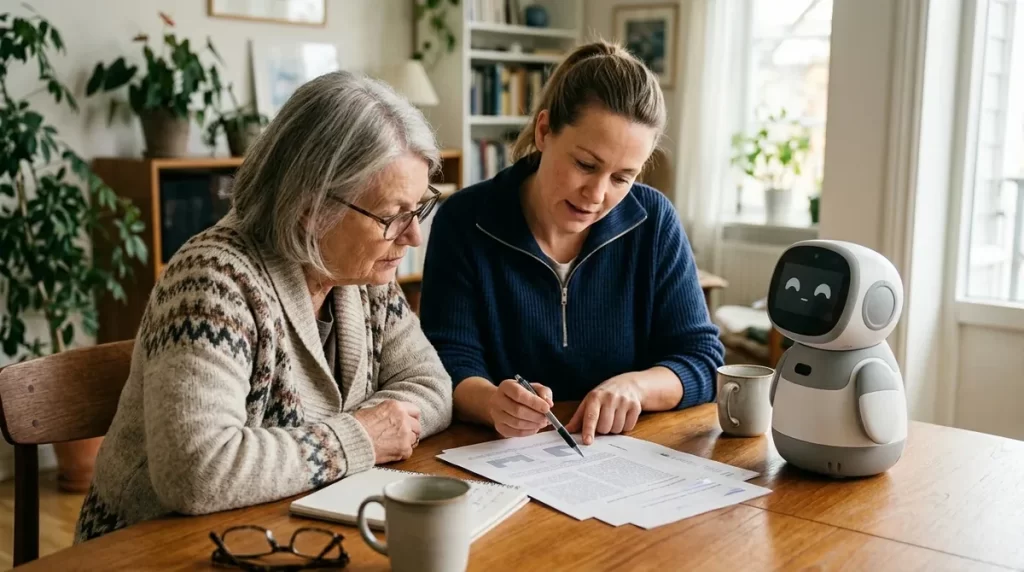
Turn expert insight into action
A practical framework for buyers, caregivers and developers
Purchase the bounded capability
- Write one job the robot must perform.
- Request a real demonstration in the intended space.
- Calculate subscription and service dependence.
- Confirm returns before emotional attachment grows.
- Prefer honest limitations over human-like promises.
Protect consent and human connection
- Let the intended user accept or refuse it.
- Do not frame surveillance as companionship.
- Keep scheduled calls, visits and professional care.
- Review distress, annoyance and dependency.
- Prepare for repair, cancellation and loss.
Document relational risk
- Include users before requirements are fixed.
- Test false beliefs about capability and empathy.
- Measure longer than the novelty period.
- Publish human-oversight and escalation roles.
- Audit updates for attachment and manipulation.
One-page evidence scorecard
Verify an expert interview before citing it
20-point source credibility checklist
Frequently asked questions
Robot companion expert insights FAQ
Did Robot Companion interview these experts?
No. This is an independently written analysis of public institutional profiles, research articles and papers. The researchers did not review or endorse this article, and we do not present paraphrases as private quotations.
Do experts agree that robot companions reduce loneliness?
No universal conclusion applies to every robot or population. Some studies in defined older-adult settings report promising psychosocial outcomes, while other reviews find small, mixed or uncertain effects. Product format, comparator, duration and human facilitation matter.
Can a robot have real empathy?
A robot can detect inputs and generate behavior that people interpret as empathic. That does not establish subjective feeling, reciprocal vulnerability or moral responsibility. Buyers should evaluate the practical effect without confusing performance with human experience.
What is socially assistive robotics?
It is a field in which robots provide assistance primarily through social interaction rather than physical force. Examples include prompting rehabilitation exercises, supporting learning or encouraging participation. Human-led goals and oversight remain essential.
Why does long-term testing matter?
Social robots often make a strong first impression. Novelty can temporarily increase attention and engagement. Longer deployments reveal whether value persists, routines fit real life, maintenance is manageable and the user still wants the interaction.
What does IEEE P7027 add?
It treats relational effects such as over-attachment, emotional dependency, role ambiguity, social displacement and anthropomorphic misattribution as safety and trust issues for relevant human–robot environments.
How can I tell whether an online expert interview is fabricated?
Verify the person on an institutional site, open the original recording or transcript, search a distinctive sentence, inspect linked studies and confirm dates and roles. Nonfunctional watch buttons, generic portraits and precise unsourced success rates are strong warning signs.
Editorial conclusion
Credible expertise makes the question smaller, not the promise bigger
Real robot companion research does not support a single story of inevitable human-level empathy or universal therapeutic success. It offers something more valuable: methods for defining a useful role, testing with the intended user, calibrating trust, protecting human relationships and planning for failure. Use experts to sharpen those decisions—then demand evidence from the actual product.
Primary sources
Researcher context: Maja Matarić at USC, Cynthia Breazeal, Kate Darling at MIT, Kerstin Dautenhahn at Waterloo and Sherry Turkle at MIT. Design evidence: interviews with 13 social-robot creators. Risk frameworks: IEEE P7027 and the NIST AI Risk Management Framework. Sources were checked July 13, 2026; institutional roles and standards may change.