Practical care guide · Updated July 2026
Where companion robots can support therapy—and where they should not
A companion robot can help deliver a structured activity, prompt practice, support communication or make repetition more engaging. It cannot diagnose a condition, understand a crisis like a trained professional or replace the human relationship at the center of good care.
What does “robot companion therapy” actually mean?
The phrase is used loosely. In research and care settings, the robot is usually part of an intervention designed by people. It may present prompts, model a social behavior, lead a game, encourage movement or provide a predictable focus for interaction. The therapeutic value comes from the complete activity—not simply from owning a robot.
Wellness companion
General conversation, entertainment, reminders or routine support without a clinical treatment claim.
Therapy support tool
A professional incorporates the robot into a defined plan while remaining responsible for assessment and treatment.
Medical device or clinical system
A product intended to diagnose, treat or mitigate a condition may face medical-device requirements depending on its claims and jurisdiction.
Merged comparison guide
Robot companion support vs. psychotherapy
The phrase traditional therapy is too vague for a clinical comparison. Psychotherapy refers to treatments that help people identify and change troubling emotions, thoughts and behaviors. According to the National Institute of Mental Health, most psychotherapy is delivered by a licensed mental-health professional, individually or in a group. A consumer robot is not another therapist with different office hours; it is software and hardware that may deliver prompts or activities.
| Dimension | Consumer robot companion | Psychotherapy with a qualified professional |
|---|---|---|
| Role | Wellness product or support tool unless a specific regulated indication says otherwise | Professional treatment selected for the person’s needs, condition and goals |
| Assessment | Cannot reliably rule out medical causes, diagnose a disorder or build a clinical formulation | Reviews symptoms, functioning, history, context, risk and possible need for other care |
| Mechanism | Prompts, scripted or generated conversation, reminders, games and embodied interaction | Uses an evidence-based therapeutic approach, professional judgment and a treatment relationship |
| Adaptation | Personalizes within available data, rules and model behavior; may produce incorrect responses | Can clarify meaning, notice context, discuss preferences and revise the plan collaboratively |
| Relationship | Performs social behavior without human understanding, vulnerability or duty of care | Creates a human therapeutic alliance with professional boundaries and accountability |
| Crisis and safeguarding | Must not be relied on to detect suicide risk, abuse, psychosis, mania or imminent danger | Trained professionals use assessment, safety planning, safeguarding and human escalation pathways |
| Confidentiality | Data use follows product terms, permissions, vendors and technical security controls | Professional confidentiality and its legal or ethical limits should be explained before treatment |
| Evidence | Must match the exact device, software, population, protocol and outcome | Many psychotherapies have evidence across large patient groups and specific disorders |
| Access model | Requires compatible hardware, internet or service region and may involve subscriptions | May be in person, group-based or remote; availability, insurance and local cost vary |
Between-session cue
Remind the user about an exercise already selected with a professional and provide a manual route if the robot is unavailable.
Structured practice
Repeat a bounded communication, learning or rehabilitation activity while a qualified person defines the goal and monitors response.
Contact bridge
Open a telehealth appointment, crisis contact or trusted-person call rather than attempting to become the destination for care.
Independent treatment selection
Do not let a consumer device choose a diagnosis, trauma protocol, exposure hierarchy, medication plan or level of care.
Crisis substitute
Do not rely on conversation sentiment, face analysis or passive monitoring to decide whether urgent human help is needed.
Unsupervised vulnerable-user care
Children and people with impaired consent, severe symptoms or confusion require safeguards that a sales claim cannot provide.
Real access barriers deserve real alternatives
Cost, waiting lists, transport, disability, language and geography can make psychotherapy difficult to reach. Those barriers do not validate an untested robot as equivalent care. Ask about telehealth, group treatment, university training clinics, community mental-health services, primary-care referral, sliding-scale fees and evidence-based guided or unguided self-help.
Compare like with like
Do not compare five years of weekly therapy with one robot purchase unless that exact treatment schedule is clinically appropriate and the robot provides an equivalent tested intervention. Include subscriptions, replacement, privacy, clinician integration and the cost of delayed effective care.
Six practical use cases
Structured social-skills practice
A predictable robot can repeat turn-taking, joint-attention or perspective-taking activities under professional guidance.
Common research setting: autism interventions
Engagement in dementia care
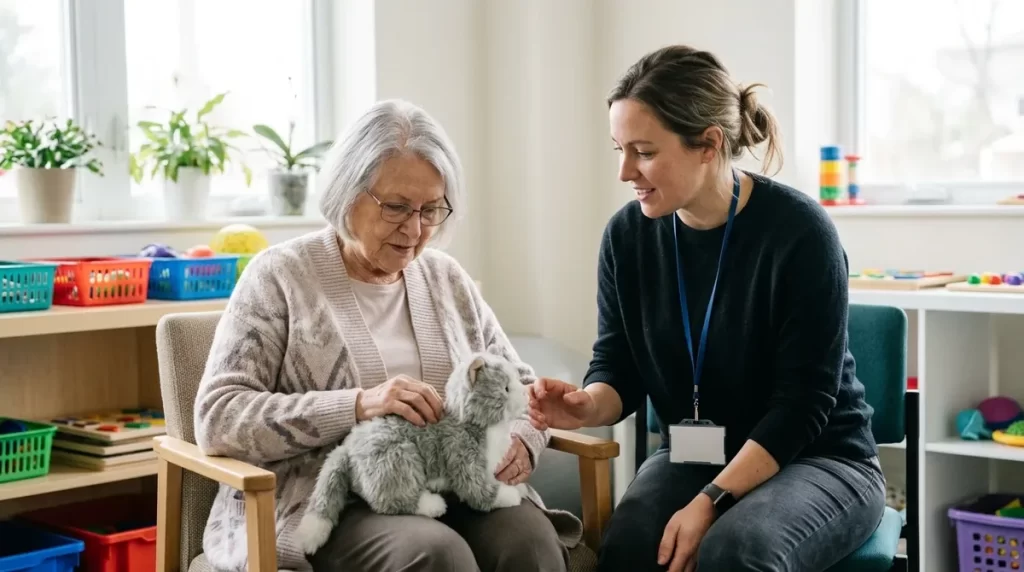
Pet-like or social robots may support conversation, sensory engagement and structured non-drug activities.
Common research setting: residential and day care
Guided cognitive activities
Games, reminiscence prompts and simple exercises can provide repeatable practice when matched to a person’s ability.
Goal: participation, not a promise to reverse disease
Communication and connection
A robot may facilitate calls, messages or contact with family and staff, especially for people who find conventional interfaces difficult.
Benefit may come partly from the human connection enabled
Routine and adherence support
Reminders can reinforce schedules, hydration, appointments or home exercises without making independent clinical decisions.
Requires a reliable escalation path when a task is missed
Motivation during practice
Social feedback, progress cues and consistent repetition may make an approved exercise or learning task more engaging.
The underlying exercise still needs professional selection
What does current research support?
The strongest claim that can be made across the field is not that robots replace therapy, but that specific robot-assisted protocols can sometimes improve engagement or targeted skills. Effectiveness depends on the protocol and comparator.
A randomized trial of 60 children compared a robotic intervention, a human-instructed program and a control condition. The robot group showed improvements in performance-based social communication and parent-reported social participation. The authors also called for maintenance-phase research to test whether effects persist.
Two randomized trials reported in 2025 compared robot-assisted protocols with conventional treatment. In one clinic trial, 69 children achieved equivalent outcomes with greater engagement; a second real-world trial of 63 children also reported outcomes equivalent to standard treatment after a shorter protocol.
Interpretation: equivalent outcomes can be valuable when a tool improves engagement or delivery, but they do not prove superiority.
A 2025 crossover trial involving 32 children compared iCub-assisted training with standard therapy and a human-assisted active control. The structured program targeted perspective-taking, joint attention and intention recognition.
Caution: small samples and specialized research systems limit immediate generalization to consumer products.
Trials and pooled analyses—especially involving PARO—provide some support for engagement, agitation and anxiety in dementia care. Evidence is less consistent for cognition, sleep, depression and long-term quality of life.
Companion robots are not the same as rehabilitation robots
The terms are sometimes mixed, but the mechanisms and risks are different. A social robot may encourage someone to complete an exercise. An exoskeleton, end-effector gait trainer or robotic hand system physically applies or guides movement and belongs to a specialized rehabilitation-device category.
| Feature | Companion or social robot | Physical rehabilitation robot |
|---|---|---|
| Primary role | Engagement, prompts, communication and social interaction | Guided movement, repetitive motor training or physical assistance |
| Contact with body | Usually limited or incidental | May transmit force or constrain movement |
| Main risks | Privacy, emotional reliance, misinformation and missed escalation | Physical alignment, force, falls, fatigue and device-specific contraindications |
| Supervision | Depends on user and intended activity | Typically requires trained clinical oversight and a defined rehabilitation protocol |
| Evidence transfer | Social-interaction findings apply only to comparable systems | Motor outcomes cannot be used to market an ordinary companion robot |

A seven-step implementation workflow
- Define one measurable goalFor example: participate in a ten-minute turn-taking activity twice weekly—not “improve mental health.”
- Review the person and settingConsider communication, sensory needs, cognition, mobility, culture, language, privacy and prior reactions to technology.
- Select the intervention, not just the productDocument who facilitates it, session length, content, frequency and what happens when the robot fails.
- Obtain meaningful consentExplain cameras, microphones, data storage and the robot’s limitations in an understandable form.
- Start with a supervised trialObserve comfort, engagement, frustration, overstimulation and whether the intended activity actually occurs.
- Measure the planned outcomeUse a suitable clinical or functional measure rather than relying only on novelty or anecdote.
- Review, adapt or stopContinue only when benefits outweigh burden, cost, privacy risk and staff time.
Who may—or may not—benefit?
Potentially useful when…
- The person enjoys predictable, repeatable interaction
- A specific activity becomes easier to initiate or sustain
- The robot supports, rather than reduces, human contact
- Language, sensory output and physical design are appropriate
- A responsible person can monitor outcomes and settings
Pause or reconsider when…
- The person shows fear, distress, fixation or confusion
- The robot reinforces a delusion or is mistaken for a human professional
- Cameras or recordings cannot be used with valid consent
- The product gives unsafe health advice or discourages human help
- Staff use it mainly to replace necessary attention or supervision
Safety, privacy and emergency escalation
AI systems can generate plausible but incorrect responses. In mental-health contexts, the World Health Organization emphasizes safety, accountability and human wellbeing. A companion robot used around emotionally vulnerable people needs boundaries that are visible in both product design and care procedures.
Human oversight
Name the professional or caregiver responsible for reviewing use, adverse reactions and changes to the plan.
Crisis pathway
The device should direct urgent concerns to appropriate human or emergency resources, not attempt independent crisis counseling.
Data minimization
Disable unnecessary recording, use the least sensitive data possible and establish deletion and access controls.
Clear identity
The robot should not misrepresent itself as conscious, licensed, clinically infallible or capable of confidentiality it cannot provide.
Equity and accessibility
Test language, hearing, vision, motor and cultural fit rather than assuming one interface works for everyone.
Service continuity
Plan for outages, subscription changes, discontinued cloud features and secure removal of stored information.
How to evaluate a product for supportive use
A consumer robot can still be useful, but therapeutic marketing should be separated from evidence. Before purchasing or recommending one, request concrete answers.
- Exact claim: What outcome does the company say the product supports, and is that a wellness or medical claim?
- Product-specific evidence: Was the same hardware and software version tested?
- Population: Did participants resemble the intended user in age, diagnosis, language and setting?
- Active ingredient: Is the benefit expected from autonomous interaction, clinician content, family communication or simple reminders?
- Safety controls: Can recording, purchases, open-ended conversation and remote access be limited?
- Support lifetime: How long are security updates, replacement parts and cloud features expected to continue?
- Total cost: Include subscriptions, training, accessories, staff time and replacement hardware.
- Return or pilot period: A supervised trial is more informative than a promotional demonstration.
Our affiliate principle
If this guide later links to a retailer, the link will identify where a product can be found—not certify it as therapy. Research quality, safety and suitability must be evaluated independently from commission.
Frequently asked questions
Is robot companion therapy a recognized treatment?
There are researched robot-assisted interventions, but the phrase itself is not one standardized treatment. Evidence and regulatory status depend on the exact device, protocol, claim and jurisdiction.
Can companion robots help autistic children?
Several controlled studies report benefits for targeted social-communication activities. They should be treated as structured support tools delivered by qualified teams, not universal replacements for established services.
Can a robot provide mental-health counseling?
A conversational product may offer general wellbeing activities, but it should not be assumed capable of diagnosis, confidential professional counseling or safe crisis management.
Are rehabilitation robots companion robots?
Usually not. Exoskeletons and robotic gait or hand systems physically support motor rehabilitation and have different evidence, supervision requirements and risks.
How should a care organization start?
Begin with one defined goal, review consent and privacy, run a small supervised pilot, measure a preselected outcome and establish clear stop criteria before broader deployment.
Are robot companions cheaper than psychotherapy?
A hardware price and a course of professional treatment are not equivalent units. Psychotherapy cost varies by country, provider, format, insurance and clinically appropriate duration. Robot ownership adds subscriptions, replacement and service risk while providing a different function.
What if psychotherapy is unavailable or has a long wait?
Ask primary care or local mental-health services about telehealth, groups, training clinics, community programs, sliding-scale options and evidence-based self-help. A robot may support routine or connection, but limited access does not make it a qualified clinician.
How this guide was prepared
We reviewed recent randomized trials, PubMed records and public health guidance. We separated social-companion interventions from physical rehabilitation devices and removed unsupported claims about certification, insurance coverage and guaranteed outcomes. This guide describes responsible implementation principles; it is not a clinical protocol.
Research and guidance cited
- Randomized trial of robotic social intervention for children with autism
- iCub-assisted social-cognition crossover trial
- Robot-assisted autism therapy: efficacy and real-world effectiveness trials
- WHO: responsible AI for mental health and wellbeing
- WHO: ethics and governance of AI for health
- NIMH: what psychotherapy is and how to evaluate a provider
- NICE: shared decision making and evidence-based depression treatment
- FDA discussion of AI/ML software and medical-device claims