Evidence and safe-use guide · Updated July 13, 2026
Calming interaction is not anxiety treatment
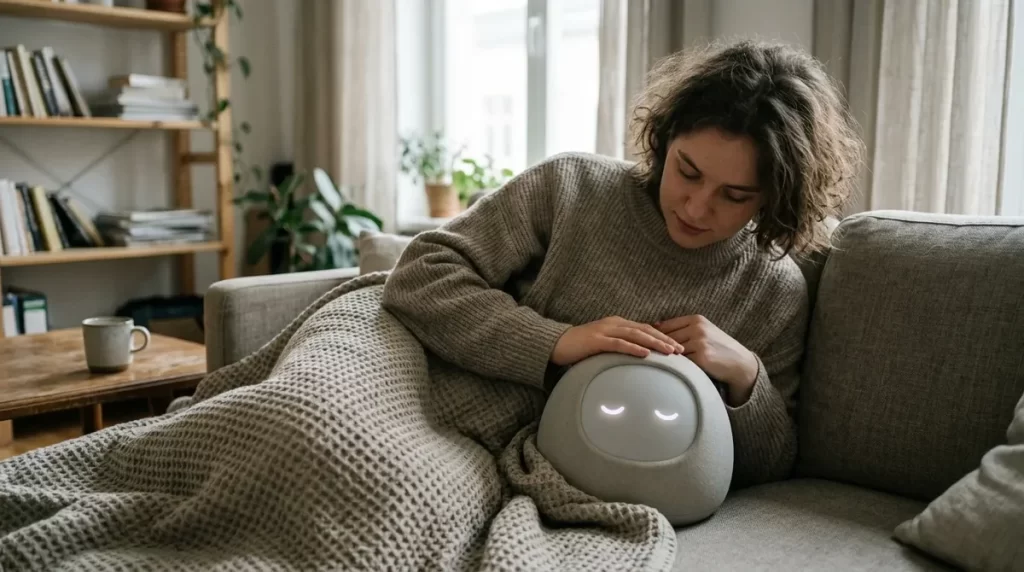
A companion robot may make a grounding routine easier to start, provide a predictable sensory focus or prompt contact with another person. Those are plausible support roles. It cannot diagnose an anxiety disorder, deliver clinician-led cognitive behavioral therapy, judge whether chest pain is panic or a medical emergency, or keep someone safe in a crisis.
4 device formatsCompared by function and burden
4-week trialBaseline, measures and stop rules
The correct frame
Start with the problem, not the product
Feeling anxious before an interview, flight or medical procedure is not automatically an anxiety disorder. A disorder involves fear or worry that is excessive, difficult to control, persistent and disruptive to daily life. Different conditions—including generalized anxiety disorder, panic disorder, social anxiety disorder and phobias—also require different assessment and treatment decisions. A consumer robot cannot make those distinctions.
The World Health Organization describes anxiety disorders as the most common mental disorders and states that effective treatment exists. Psychological interventions, especially those based on cognitive behavioral therapy (CBT), have the strongest evidence across anxiety disorders. NICE guidance uses stepped care: education and monitoring may be appropriate at one stage, while structured self-help, clinician-delivered CBT, applied relaxation or medication may be appropriate at another. A robot is not listed as a treatment and should not be marketed as one.
Name one situation
Define the moment you want to improve: settling before bed, beginning a clinician-assigned exercise or taking a planned work break.
Choose one support
Decide whether you need a tactile object, a routine cue, a simple distraction or a prompt to contact a person.
Protect treatment
Keep appointments, medication decisions and exposure work under the plan agreed with qualified professionals.
Measure function
Track whether the routine helps you do what matters, not whether the robot produces a momentary smile.
What research actually shows
Promising signals exist, but they do not prove treatment of anxiety disorders
Robot research often measures state anxiety—how tense someone feels during a particular procedure or session. That is different from treating a diagnosed disorder over months. Studies also combine different ages, robots, facilitators, settings, comparison groups and outcome scales. Novelty, researcher attention and extra human contact can contribute to the result.
10 randomized trials, 877 children
A systematic review reported lower anxiety among children ages 4–12 interacting with social robots during clinical procedures. The result applies to short, supervised clinical encounters—not home treatment of an anxiety disorder.
Emotional outcomes remained uncertain
A later meta-analysis found a clearer benefit for pain, while pooled anxiety, fear and distress effects were not statistically significant and prediction intervals were wide. This illustrates why one positive review is not a universal verdict.
No significant pooled anxiety benefit
A review of randomized studies found encouraging narrative observations for engagement and stress, but its meta-analysis did not find statistically significant effects on anxiety or other main outcomes.
| Claim | Current reading | What would be reasonable to say | What would overstate the evidence |
|---|---|---|---|
| Distraction during a pediatric procedure | Several randomized studies show a short-term signal, although newer pooling is mixed. |
A trained team may consider a robot as one supervised non-drug distraction option. | “Robots treat childhood anxiety.” |
| Brief stress or tension at home | Predictable interaction may help some people pause or redirect attention. |
A device can be tested as an optional cue inside an existing coping routine. | “Scientifically proven instant anxiety relief.” |
| Generalized anxiety or panic disorder | Consumer companion robots have not established durable clinical effectiveness. |
Use only as an adjunct if it does not interfere with evidence-based care. | “A replacement for CBT or medication.” |
| Crisis detection or prevention | A consumer device may misunderstand, fail, lose connectivity or miss nonverbal danger. |
Use human crisis services, a safety plan and emergency care. | “The robot will know when you are unsafe.” |
Realistic support roles
What a companion robot may help you practice
The safest use cases are small, observable and reversible. They make a healthy action easier without asking the robot to interpret symptoms or impersonate a therapist.
Orient to the present
Touching a textured surface, noticing movement or naming visible details may help redirect attention during mild tension.
Success looks likeYou return to the planned activity; the robot is not required every time.
Start a planned pause
A scheduled cue can mark a two-minute break, hydration, stretching or another routine already chosen with appropriate guidance.
Success looks likeThe cue is reliable, dismissible and does not interrupt sleep or concentration.
Rehearse a script
A predictable device may offer low-stakes repetition before a call or presentation, provided it does not replace real-world practice.
Success looks likeRehearsal leads toward the real task instead of becoming a safety behavior.
Prompt human contact
A reminder can suggest calling a trusted person, joining a group or attending an appointment already in the care plan.
Success looks likeHuman relationships increase rather than shrink.
Create joint attention
Using a robot with a family member, caregiver or clinician can create a neutral topic and shared activity.
Success looks likeThe person remains in control and the interaction supports conversation.
Record a simple outcome
A manual note can capture situation, distress before and after, action taken and whether you completed the next step.
Success looks likeMinimal data answers a defined question without building an intimate surveillance archive.
A robot can…
- offer a predictable sensory focus;
- play a user-selected audio routine;
- give a scheduled reminder;
- support brief rehearsal;
- be part of a shared activity;
- make a chosen habit feel more engaging.
A robot cannot safely…
- diagnose panic, anxiety or another condition;
- exclude heart, breathing or neurological emergencies;
- conduct unsupervised exposure therapy;
- adjust medication or provide clinical instructions;
- guarantee confidentiality or constant availability;
- replace crisis counselors, clinicians or trusted people.
Choose by function
Four formats, four different tradeoffs
There is no clinically established “best robot for anxiety.” Compare the lowest-complexity option that can support your one defined goal. Product features, service regions and subscriptions change, so verify current documentation before purchase.
| Format | Possible fit | Strength | Main burden | Questions before buying |
|---|---|---|---|---|
| Non-connected interactive pet | Tactile focus, simple shared activity | Lower setup and data exposure | Repetitive behavior; may still be costly or overstimulating | Can sound be muted? Is it washable? Can it work fully offline? |
| Therapeutic robotic animal | Structured programs in health or care settings | Designed for supervised interaction; some products have published studies | High price, infection-control and staff-training needs | Which exact model was studied? Who facilitates and cleans it? |
| Mobile social companion | Touch, movement and household engagement | Rich, expressive interaction | Very high ownership cost, maintenance, cameras, connectivity and service dependency | What works without cloud service? What data leave the home? Is local support available? |
| Conversational companion | Reminders, guided activities and connection prompts | Flexible language interaction | False confidence, intimate disclosures, transcription and hallucinated responses | Is it designed for emergencies? Can recordings be deleted? Can sensitive features be disabled? |
PARO
PARO is a seal-shaped therapeutic robot with tactile, light, audio, temperature and posture sensors. It is often studied in hospitals and long-term care, especially dementia contexts. That history does not establish it as a treatment for anxiety disorders or justify an expensive home purchase.
LOVOT
LOVOT is a mobile social companion built around touch, gaze and expressive behavior. The manufacturer describes comfort and emotional engagement, not an “Anxiety Edition.” Pricing includes substantial hardware and, depending on the plan and region, ongoing software or care costs.
Start without AI
If the goal is a tactile pause or routine cue, first compare a non-connected object, timer, audio track, real pet interaction or support from another person. A more complex robot should earn its added cost, data collection and maintenance burden.

Test before you depend
A four-week trial that can produce a real decision
Use a return window, rental, demonstration or borrowed device whenever possible. Avoid judging the robot during the first exciting days. The goal is not to prove that it works; it is to discover whether it adds measurable value beyond simpler alternatives.
Baseline
Without the robot, record the chosen situation, distress from 0–10, minutes until the next valued action and whether you completed it.
Introduce
Use one feature for no more than one planned session per day. Keep therapy, medication, sleep and other routines unchanged where possible.
Compare
Alternate the robot with a simpler option such as a timer, textured object or human check-in. Compare function, not novelty.
Generalize
Try the skill once without the robot. A useful support should help build flexibility rather than exclusive dependence.
Write the test in one sentence
When I notice moderate pre-meeting tension, I will use one two-minute tactile interaction, then open my notes and join the meeting, and measure completion plus distress before and ten minutes after. I will stop if the device increases distress, delays attendance or feels mandatory.
A safe session sequence
- 01
Check the context.
Do not begin if symptoms are severe, unusual, medically concerning or part of an emergency.
- 02
Choose the next valued action.
Name what happens after the session: return to work, prepare food, make a call or follow the professional care plan.
- 03
Set a short limit.
Use a visible timer, typically two to ten minutes depending on the agreed goal.
- 04
Keep control accessible.
Volume, motion, camera and power controls must be easy to reach. Stop immediately if interaction feels intrusive.
- 05
Use a familiar skill.
Follow only techniques you already know are appropriate. If slow, comfortable breathing is in your plan, do not force deep breaths; stop if dizzy or more distressed.
- 06
Transition outward.
End on time and begin the named real-world action. Do not wait for a perfect emotional state.
- 07
Record minimally.
Note completion, distress and any problem. Avoid storing free-form intimate disclosures when a short score is enough.
- 08
Review weekly.
Continue, simplify or stop based on function, flexibility, privacy, cost and the advice of the relevant professional.
The routine reliably supports the next action, remains optional and adds value beyond a simpler tool.
There is some benefit, but sound, timing, session length, data collection or facilitator behavior needs adjustment.
Distress, avoidance, sleep disruption, spending, surveillance, conflict or reliance increases—or no functional benefit appears.
Psychological and data safety
The most intimate risk may not be the camera
An anxious user may disclose fears, health details, relationship conflict, location and crisis language to a device that sounds empathic. The system may store audio, transcripts, usage patterns or account data, while its warm responses encourage more disclosure than the user would give an ordinary appliance. Apparent empathy is generated behavior, not confidentiality, clinical judgment or a duty of care.
Intimate records
Identify what is captured, where it is processed, who can access it, how long it remains and whether deletion covers backups and transcripts.
False reassurance
A fluent answer may be wrong. Never let a device decide that physical symptoms are “just anxiety” or that professional help is unnecessary.
Dependency
Watch for panic when offline, escalating use, withdrawal from people, inability to act without the robot or distress about service shutdown.
Bystander privacy
Housemates, visitors and clinicians may be recorded without meaningful notice. Use visible indicators and disable sensors where possible.
Before setup
- Create a dedicated account and strong unique password.
- Enable multi-factor authentication if available.
- Read the privacy and retention settings, not only the marketing page.
- Disable voice history, personalization and remote access unless required.
- Decide which rooms and times are device-free.
During use
- Avoid names, diagnoses, addresses and financial details.
- Use a manual rating instead of an open-ended emotional diary.
- Review account activity and connected household members.
- Install security updates and verify microphone/camera indicators.
- Delete test data before returning, selling or transferring the device.
Human care comes first
When to seek professional or urgent help
Talk with a qualified health professional when fear or worry is persistent, difficult to control, causes significant distress, interferes with school, work, sleep or relationships, leads to avoidance, or is accompanied by repeated panic attacks, substance use or depression. A clinician can evaluate anxiety as well as medical conditions and medication effects that can resemble it.
Symptoms are affecting daily life
Ask for an assessment and discuss evidence-based options. Bring a brief record of situations, duration, impairment, sleep, substances, medications and what you have tried.
Symptoms are changing or escalating
Seek timely help for rapidly worsening anxiety, repeated panic, inability to function, major sleep loss, medication reactions or increasing reliance on alcohol or drugs.
Safety or physical danger is possible
Use emergency services for immediate danger, inability to stay safe, severe chest pain, fainting, new weakness, severe breathing difficulty or other symptoms that may be a medical emergency.
Print or save
24-point anxiety companion checklist
Frequently asked questions
Robot companions and anxiety: common questions
Can a robot companion cure anxiety?
No. Anxiety disorders have evidence-based psychological and medical treatments, but consumer companion robots have not been shown to cure them. A robot may be tested as an optional support for a narrow routine.
Can a robot stop a panic attack?
Do not rely on one to do so. A familiar cue may feel grounding for some people, but a robot cannot confirm that symptoms are panic, exclude a medical emergency or provide reliable crisis assessment. Follow your clinician-created plan and seek urgent care when appropriate.
Which robot is best for anxiety?
There is no clinically validated overall winner. Start with the desired function, sensory preferences, privacy limits and total cost. Test the simplest reversible option before buying an expensive connected robot.
Is PARO approved to treat anxiety?
PARO has a history in supervised therapeutic and care settings and has been studied for several outcomes, particularly among older adults. That does not make it an established treatment for an anxiety disorder. Ask which exact population, outcome and protocol support any claim.
Should I tell the robot about my fears?
Assume sensitive speech could be processed or stored unless current documentation proves otherwise. Prefer minimal structured notes, review privacy controls and reserve clinical details for qualified professionals using appropriate systems.
Can a robot lead breathing exercises?
It can play a preselected cue, but breathwork is not universally comfortable. Forced deep breathing may increase dizziness or distress. Use only a technique that is appropriate for you, keep breathing comfortable and stop if symptoms worsen.
What if I become attached to the robot?
Attachment is not automatically harmful. Reassess if the device replaces relationships, becomes necessary for ordinary tasks, causes distress when unavailable or creates spending and privacy problems. Plan for repairs and service shutdown before purchase.
Bottom line
Buy a support tool only after defining the human plan
A companion robot may help some people pause, practice, connect or complete a routine. The strongest positive research is still tied to narrow, supervised contexts, while direct evidence for treating anxiety disorders at home is insufficient. Choose one goal, protect clinical care, minimize data, compare a simpler option and stop if the device increases avoidance or dependence.
How this guide was reviewed
Clinical framing was checked against the WHO anxiety disorders fact sheet, NICE guideline CG113 and NIMH psychotherapy guidance. Robot claims were limited using systematic reviews indexed by PubMed and current manufacturer pages. Evidence is described by population and setting; marketing language is not treated as clinical proof. Product availability, features, prices and privacy terms can change, so verify them immediately before purchase.