Evidence, ethics and selection guide · Updated July 13, 2026
The goal is access and agency—not acting less autistic
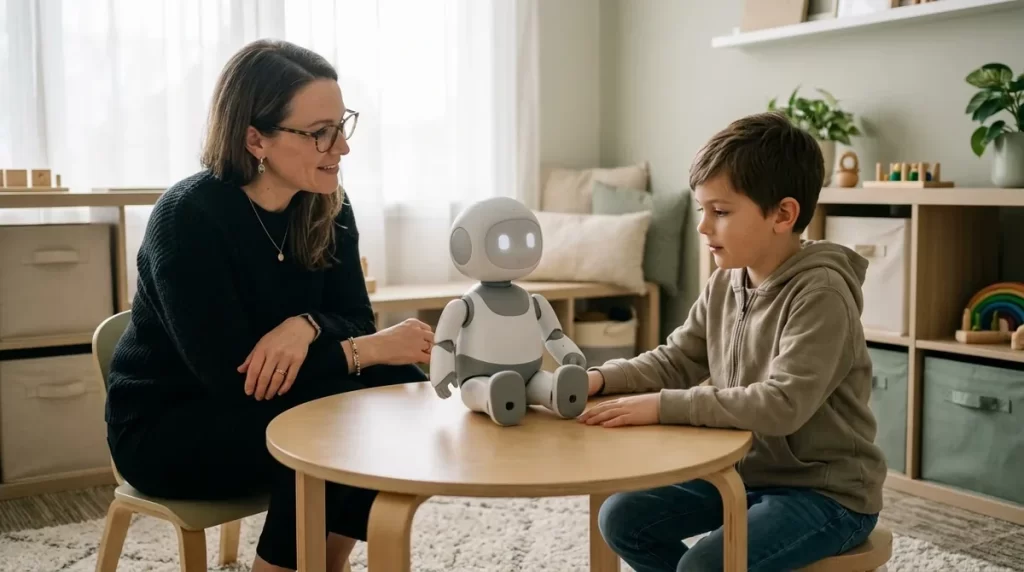
A social robot can sometimes make a learning activity predictable, repeatable and engaging. It may support a specific communication, play or daily-living goal when an autistic person wants to use it and a skilled adult shapes the activity. It is not a cure, diagnostic tool, substitute for augmentative and alternative communication (AAC), or universal way to teach “normal” behavior.
3 product casesNAO, Leka and the Moxie lifecycle
6-week pilotGoals, measures, consent and stop rules
Begin with the person
Autism support cannot be reduced to a feature list
Autistic people differ in communication, language, cognition, movement, sensory processing, health, interests, daily-living skills and desired support. The same person may need little support in one setting and substantial support in another. A diagnostic label or support-level descriptor cannot tell a buyer whether speech recognition will work, whether flashing lights will hurt, or whether a humanoid face will be engaging or frightening.
NICE guidance emphasizes individualized care, communication access, environmental adjustments and participation in decisions. For children and young people, social-communication interventions should be adjusted to developmental level, involve trained professionals and increase the responsiveness of adults to the child’s communication. For adults, support should promote autonomy, active participation and self-management. Those principles should govern any robot session.
Ask, observe, respect
Seek the person’s assent or consent in an accessible way. Turning away, covering ears, freezing, pushing the robot aside or leaving are meaningful responses.
Presume communication
Speech is only one mode. Gestures, signs, typing, symbols, AAC, movement and behavior can all communicate needs and preferences.
Choose functional goals
Prioritize requesting a break, making choices, preparing for a transition or completing a valued activity over cosmetic compliance.
Adapt the environment
Reduce noise, glare, unpredictability and waiting before asking the person to tolerate more stimulation or practice.
Keep human facilitation
A trained adult interprets responses, adjusts difficulty, models communication and helps transfer learning to daily life.
Make exit easy
The person can pause, refuse or stop without losing praise, access to communication, preferred activities or other support.
What research supports
Robot-mediated interventions are promising but not ready for blanket recommendations
Most research involves children, small samples, short programs and robots operated or supervised by researchers, clinicians or teachers. Outcomes often measure performance during the robot session rather than whether a skill transfers to classmates, family, school, work and community life. Adults and people with higher support needs remain underrepresented.
40 studies; 17 randomized trials
Twelve randomized trials entered the meta-analysis. Robot-mediated interventions showed a small improvement in social functioning, while emotional and motor outcomes were not significant. Most programs targeted children and social communication.
14 studies; 408 children
The pooled result was positive, but effects varied by robot role, developmental domain, region, design and control group. Greater teacher involvement was associated with stronger results—evidence for facilitated programs, not autonomous robot therapy.
Only 10 studies met criteria
Parent participation appeared feasible and potentially useful, but the authors emphasized how few studies had directly examined it. Promising feasibility is not proof of a particular home product or protocol.
| Question | Evidence reading | Reasonable conclusion | Remaining gap |
|---|---|---|---|
| Can a robot increase engagement during a structured session? | Multiple studies report attention or participation signals. |
Some autistic children may find a predictable robot motivating for a defined activity. | Novelty, facilitator attention and individual preference can drive the result. |
| Can it support social-communication learning? | A meta-analysis found a small pooled social-functioning effect. |
Consider only as one component of a professional, individualized program. | Generalization and durability are inconsistently measured. |
| Does a consumer robot provide autism therapy? | Research protocols do not validate every commercial device, app or conversation. |
Match the exact model, software, facilitator and task to relevant evidence. | Independent comparative trials and long-term home evidence are scarce. |
| Does it help autistic adults? | The literature is dominated by children and adolescents. |
Adults should not be treated as an extension of pediatric findings. | Adult-defined outcomes, employment, independent living and quality of life need study. |
| Can it replace AAC or human support? | A robot is not a dependable communication system or responsible support person. |
Protect existing AAC and human relationships throughout the pilot. | Failure, misrecognition and service loss can remove access at critical moments. |
What to work on
Seven goals a robot may support without trying to “fix” autism
A strong goal is chosen with the autistic person, relevant to daily life and measurable without demanding masking. The robot is a temporary teaching or participation tool; the skill must remain available with people and in real environments.
Express a preference
Select between two activities, indicate “more,” “finished” or “different,” and have that choice honored.
MeasureIndependent, understandable choices across partners and settings.
Request pause or help
Practice a spoken word, sign, card, button or AAC message that immediately changes the activity.
MeasureRequests recognized before distress escalates.
Preview what comes next
Use a short visual sequence or demonstration to prepare for a real routine such as packing a bag or entering class.
MeasureGreater predictability and smoother participation, not perfect compliance.
Share control
Alternate activating the robot, choosing a movement or adding to a joint activity with a willing partner.
MeasureEnjoyable reciprocity without forced gaze or touch.
Rehearse a self-chosen script
Prepare a workplace question, medical request, classroom phrase or personal-safety response important to the user.
MeasureUse with a real person while preserving authentic communication style.
Sequence a task
Break a preferred or necessary routine into accessible steps, with adjustable prompts and a clear finish.
MeasureMore independence or less effort in the actual environment.
Share a valued interest
Program movement, music, stories or coding around the person’s interests simply because participation is enjoyable.
MeasureVoluntary engagement, positive affect and opportunity for connection.
Protect AAC at all times
AAC can include signs, gestures, objects, picture boards, letter boards, speech-generating devices and text. ASHA describes it as supplementing or compensating for communication needs and emphasizes multimodal, functional communication. Never remove, hide or delay access to a person’s established system to make robot interaction easier.
- The robot should accept the existing communication mode.
- Vocabulary must include refusal, break, pain, help and finished.
- Speech recognition failure is a device failure, not user failure.
- Prompts should fade without reducing communication access.
- Data export is not a substitute for the person’s AAC system.
Current product reality
NAO, Leka and Moxie are not interchangeable autism products
The old draft invented special editions and ratings. In practice, each product belongs to a different category, buyer and support model. Availability, regional sales, apps and subscriptions can change; verify current terms immediately before committing funds.
NAO
NAO is a programmable humanoid platform used in research, education and rehabilitation. United Robotics Group promotes partner applications for structured activities, including work with neurodevelopmental differences. There is no universal “NAO Autism Research Edition” that delivers a validated intervention out of the box.
- Best fit
- University, clinic or school with programming, procurement and trained staff
- Main strength
- Customizability and a large research history
- Main risk
- High total cost and confusing a platform with a clinical program
Leka
Leka combines a spherical robot, iPad app and activity library. Its documentation positions it as a tool in professionals’ educational practice and describes adjustable lights, vibration, motion and visual instructions. Those sensory features can engage one person and overwhelm another.
- Best fit
- Professional-led programs with a defined learning objective
- Main strength
- Structured activities and adjustable difficulty
- Main risk
- iPad compatibility, sensory load and limited independent comparative evidence
Moxie
Moxie was marketed as a conversational child companion. Original maker Embodied announced closure and said core features could not work without its cloud. A different company later acquired Moxie rights and published new terms. That history makes service continuity, device eligibility, data control and an emotionally safe shutdown plan essential purchase questions.
- Best fit
- Only after verifying the current company, service region, eligible hardware and subscription
- Main strength
- Conversational engagement and guided activities
- Main risk
- Cloud dependence, privacy, open-ended responses and attachment
| Decision factor | NAO | Leka | Moxie-type companion | Lower-tech alternative |
|---|---|---|---|---|
| Typical buyer | Institution or research program | Professional service or school | Family, subject to current availability | Family, school or individual |
| Human expertise | High: programming and intervention design | Moderate to high: activity selection and facilitation | Adult supervision and account/privacy management | Varies; often easier to understand and adapt |
| Cloud exposure | Depends on software stack | App and update dependencies | Often central to core function | Can be completely offline |
| Sensory profile | Voice, motors, humanoid motion and lights | Lights, vibration, movement and screen | Voice, facial display, movement and conversation | Can use paper, object, timer or existing AAC |
| Evidence transfer | Research does not validate every custom program | Manufacturer activities need outcome-specific evaluation | Consumer claims require independent evidence | May already be supported within established practice |
| Exit risk | Maintenance, staff turnover and obsolete software | Hardware/app compatibility and service access | Subscription or company shutdown may change the relationship abruptly | Usually easier to replace without loss of identity or data |
Pilot before purchase
A six-week person-centered evaluation
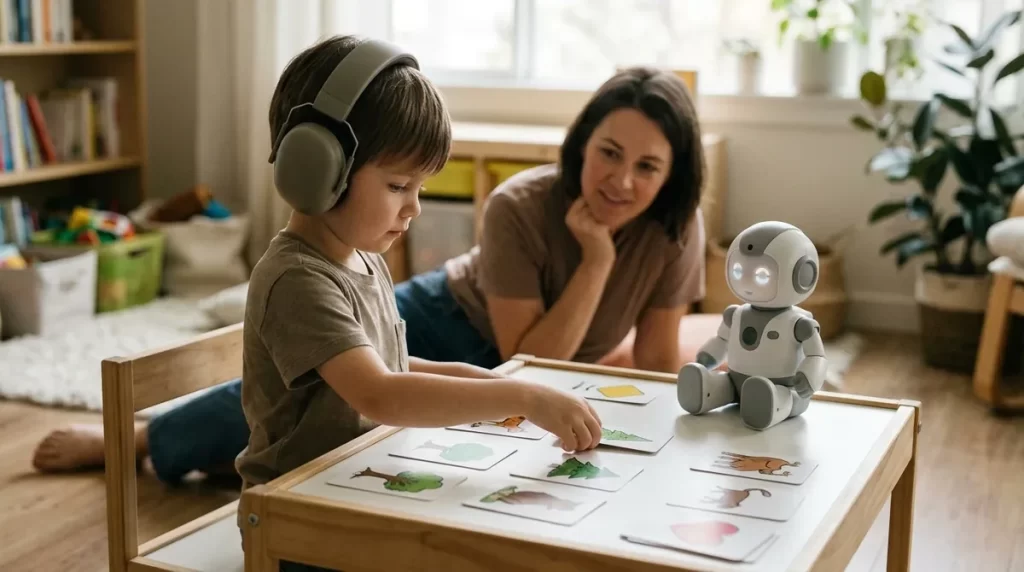
Use a loan, rental, demonstration unit or return period where possible. A team may include the autistic person, family or chosen supporter, teacher, speech-language therapist, occupational therapist, psychologist or other relevant professional. Not every pilot needs every role, but one person must own setup, safety, data review and follow-through.
Co-design
Choose one meaningful goal, communication access, sensory settings, consent signals, stop rules and a simpler comparison.
Baseline
Measure the activity without the robot: opportunities, independent responses, prompt level, distress and completion.
Introduce
Use short predictable sessions with one trained facilitator. Change only one variable at a time.
Generalize
Practice the same goal with another person, tool and real setting. Reduce robot prompts without reducing support.
Decide
Compare benefit, preference, independence, workload, privacy and total cost. Continue only if value is clear.
Example of an ethical, measurable goal
During a chosen ten-minute game, Jordan will have access to their AAC device and can select go, change, help, break or finished. The facilitator will honor each message immediately and record independent choices and prompt level. The skill will also be practiced with a person and a non-robot toy. The session stops after any refusal or repeated distress signal.
Session protocol
- 01
Prepare the space.
Reduce competing noise and visual clutter; keep the exit, communication system and comfort items available.
- 02
Preview the sequence.
Show start, activity, break and finish using the person’s preferred visual or communication format.
- 03
Offer, do not impose.
Ask whether to begin. Honor refusal and never use access to the robot as leverage for unrelated compliance.
- 04
Use the least prompt.
Wait long enough for processing, then offer only the support required. Avoid rapid repeated questions.
- 05
Follow communication.
Respond to speech, AAC, gesture, movement and behavior. Do not reward only the mode easiest for the machine.
- 06
Watch sensory load.
Lower sound, light or motion at the first sign of discomfort. A setting can be changed between sessions, not endured.
- 07
Transfer the skill.
Repeat the meaningful action with a human partner or in the real routine while the experience is fresh.
- 08
End predictably.
Give a clear finish signal, save only necessary data and record the person’s preference about another session.
- Accepted or declined
- Minutes willingly engaged
- Choice of activity
- Independent messages
- Modes used
- Requests honored
- Prompt level
- Facilitator workload
- Setup failures
- Use with people
- Use in real settings
- Use without robot
- Distress signals
- Recovery time
- Enjoyment indicators
The person chooses it, the goal improves, skills transfer and benefit exceeds burden and cost.
Preference is positive but sensory settings, task difficulty, timing, prompts or facilitator practice need adjustment.
There is refusal, distress, masking pressure, lost AAC access, no transfer, high workload, privacy concern or no meaningful benefit.
Sensory, physical and digital safety
A robot can add barriers while appearing accessible
Test each risk separately. A device that is predictable in conversation may still be unpredictable in motion; a smooth shell may still vibrate painfully; a friendly voice may fail to understand AAC output; a cloud system may store a child’s face, voice and behavioral profile.
Sound, light and motion
Measure volume, motor noise, flash, brightness, vibration, speed and proximity. Create a silent, still starting mode.
Movement and access
Check pinch points, tipping, hot surfaces, charging cables, small parts and collisions with mobility equipment or service animals.
Misrecognition
Log false responses by the machine. Never portray accent, echolalia, delayed response, motor difference or AAC output as failure.
Attachment and shutdown
Explain what the robot is, keep relationships plural and prepare an accessible story for repairs, returns or permanent service loss.
Child and household data
Minimize profiles, recordings, video, transcripts and emotion labels. Obtain appropriate consent and protect bystanders.
False authority
The robot must not solicit secrets, provide private chat beyond adult oversight, give medical advice or become the route for reporting danger.
Before activation
- Map every sensor, account, cloud service and third party.
- Document who can view recordings and progress reports.
- Disable features unrelated to the one agreed goal.
- Create separate adult administrator and user access.
- Confirm deletion, export, warranty and end-of-service terms.
Before every session
- Check volume, speed, floor area and emergency stop.
- Keep AAC, break card and preferred regulation tools available.
- Tell everyone present when recording is active.
- Use a short data sheet instead of continuous surveillance.
- Review incidents and preferences before repeating the activity.
Print or save
28-point autism robot evaluation checklist
Frequently asked questions
Robot companions and autism: common questions
Can a robot cure autism?
No. Autism is a lifelong neurodevelopmental difference. Support can improve communication access, daily functioning, participation, health and quality of life, but a robot does not cure autism and should not be sold with that promise.
Are robots proven to improve social skills?
Reviews find promising and sometimes positive average effects in structured child-focused programs, including a small pooled social-functioning effect. Studies are heterogeneous, and transfer to daily life is not guaranteed. Evaluate the exact program, person and outcome.
Which robot is best for an autistic child?
There is no universal best product. Start with communication mode, sensory profile, interests, goal, facilitator capacity and total cost. A low-tech visual support or existing AAC feature may be more useful and reliable.
Should a robot teach eye contact?
Eye contact should not be a default compliance target. It can be uncomfortable or distracting and is not required for attention, understanding or respect. Focus on communication, shared activity and outcomes the autistic person values.
Can a robot replace a speech-language therapist?
No. A qualified professional assesses communication, helps select and customize AAC, designs intervention and monitors progress. A robot can only deliver a limited activity within that human-led plan.
Is Moxie an autism-specific robot?
Do not assume an “Autism Edition” exists. Moxie has been marketed as a child-focused conversational companion. Its corporate and cloud-service history also makes current operator, hardware eligibility, subscription, privacy and shutdown terms essential checks.
What if the person only wants to interact with the robot?
Respect the interest while examining why human environments may be exhausting or inaccessible. Keep the robot as one valued activity, make human interaction safer and more accommodating, and watch for distress, isolation or loss of other opportunities.
Can adults benefit from robot-mediated support?
Possibly, if an adult chooses a specific function such as rehearsal, reminders or a shared technical interest. Direct evidence for autistic adults is limited, so use adult-defined goals and do not extrapolate pediatric social-skills programs.
Bottom line
A good robot program changes the environment as well as the task
Robot-mediated activities can be engaging and useful for selected people, especially when they are predictable, brief, professionally facilitated and tied to communication or participation in real life. The purchase is justified only when the person chooses it, AAC and autonomy remain protected, sensory and privacy risks are controlled, and measured benefit transfers beyond the machine.
How this guide was reviewed
Care principles were checked against NICE guidance for autistic children and young people, NICE guidance for autistic adults, the CDC overview of autism interventions and the ASHA AAC Practice Portal. Robot evidence was drawn from systematic reviews and meta-analyses indexed by PubMed. Product descriptions and lifecycle notes were checked against current manufacturer or operator pages on July 13, 2026. Features, ownership, subscriptions and regional availability may change.