Evidence-based guide · Reviewed July 13, 2026
A robot can prompt the next step. It cannot treat depression alone.
Robot companions may make a routine easier to start, offer a pleasant activity or prompt contact with another person. Those are plausible support roles—not proof that a device diagnoses, treats or prevents depression. This guide separates the evidence from the sales language and shows how to test a robot without displacing human care.
Human care stays centralPsychotherapy and medication have established clinical roles
One goal per trialMeasure a specific routine or connection outcome, not “companionship”
Start with the health question
Depression is more than a difficult day
Depression can involve persistent low or irritable mood, loss of interest or pleasure, fatigue, sleep or appetite changes, poor concentration, guilt, hopelessness and thoughts of death. The World Health Organization distinguishes a depressive episode from ordinary mood changes by its duration, pattern and effect on daily functioning. The diagnosis is not something a consumer robot can make from a voice, face, activity log or questionnaire.
Professional assessment matters because similar symptoms can appear with grief, chronic pain, thyroid and other medical conditions, medication effects, substance use, trauma, dementia and bipolar disorder. A history of unusually high energy, much less need for sleep, racing thoughts or risky behavior can point toward mania or hypomania and changes the clinical approach. An automated “mood score” cannot safely resolve those differences.
Symptoms
Notice duration, severity and loss of function—not just whether someone sounds sad in one conversation.
Context
Health, medication, sleep, grief, safety, substance use and prior episodes belong in the assessment.
Preferences
Treatment decisions should be shared, informed and compatible with the person’s needs and values.
Follow-up
Symptoms and side effects need human review; a device dashboard is not clinical monitoring by itself.
What research actually shows
Promising activity, uncertain antidepressant effect
The central limitation is population mismatch. Most social-robot studies measure short-term outcomes in care homes, older adults with cognitive impairment or people living with dementia. Those findings cannot simply be transferred to a younger adult with major depressive disorder, postpartum depression, bipolar depression or severe recurrent depression.
Small effect in cognitive impairment
A 2026 meta-analysis of eight randomized trials and 514 older adults with cognitive impairment found a small reduction in depressive symptoms. The benefit appeared in dementia, not mild cognitive impairment, and in interventions of six weeks or less, not longer ones.
No significant depression effect
A 2025 meta-analysis of 15 randomized dementia studies found improvements in agitation and anxiety but no significant effect on depression, cognition or quality of life. Different robots, controls, settings and schedules make pooled results unstable.
Benefit remains unclear
A review of 66 dementia studies found robots generally feasible and acceptable, yet its meta-analysis found no clear benefit for depression or other clinical outcomes. Acceptability and novelty are not the same as treatment effectiveness.
| Question | What is known | What is not established | Responsible conclusion |
|---|---|---|---|
| Can a robotic pet create a pleasant moment? | Short sessions can be engaging and acceptable for some older adults, including people with dementia. | Whether the response persists after novelty fades or improves broader functioning. | Test the activity, preference and burden. |
| Can it reduce depressive symptoms? | Some pooled analyses report small short-term changes in narrow older populations. | A consistent effect across reviews, age groups, diagnoses and longer follow-up. | Do not promise a health outcome. |
| Can it treat major depressive disorder? | No robust body of trials establishes consumer robot companions as a treatment for major depression. | Comparative effectiveness, dose, durability, adverse effects and who benefits. | Never replace clinical care. |
| Can it prevent suicide or detect crisis? | Consumer devices may offer generic prompts or contact shortcuts. | Reliable risk detection, emergency response or continuous safety coverage. | Use a human safety plan and crisis services. |
Why reviews disagree
Robot studies often combine dissimilar products, from a seal-shaped tactile device to a conversational screen. Trials may compare usual care, an activity, a live animal or another technology; measure different scales; use small samples; and last only a few weeks. Staff attention and novelty can also influence results. A statistically significant average change does not prove that the robot caused meaningful recovery for an individual.
A narrower, safer job description
Six support roles worth testing
A useful robot does not need to imitate a therapist. It needs to make one agreed action easier, more pleasant or more consistent while preserving the person’s autonomy. Each role below should connect to a human-authored plan and have a manual alternative.
Begin one small action
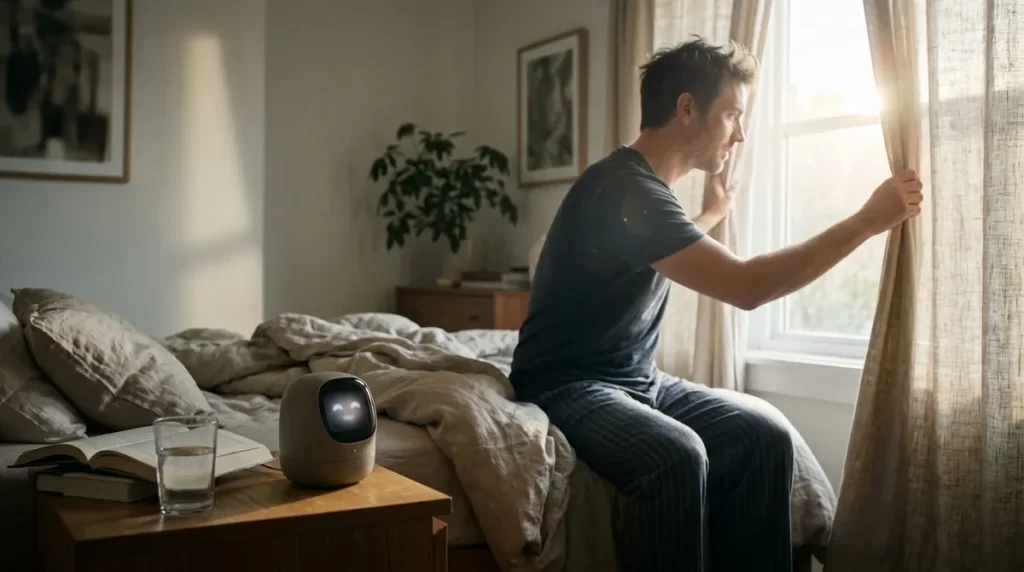
Prompt opening curtains, drinking water, preparing breakfast or starting a hygiene routine at a chosen time.
MeasureWas the action easier to begin?
Reach a real person
Offer a one-tap call or a prompt to message a trusted contact without pretending that machine conversation equals reciprocal support.
MeasureDid meaningful human contact increase?
Create a reason to join
Use music, photos, trivia or gentle play with a family member, peer or care worker instead of isolating the user with the device.
MeasureDid participation and enjoyment improve?
Add a low-demand moment
Touch, movement or a familiar sound may offer brief sensory engagement when the person voluntarily enjoys it.
MeasureCalmer or more engaged afterward?
Support an existing plan
Remind the user about therapy, a support group or a medical appointment and provide the correct contact shortcut.
MeasureFewer missed appointments?
Prepare for human care
Store a simple, user-controlled note about sleep, energy or questions to discuss with a clinician—without automated diagnosis.
MeasureWas the clinical conversation clearer?
- cue a user-selected action;
- play a familiar activity;
- open a contact or appointment;
- work as a shared social object;
- repeat neutral instructions.
- diagnose depression or bipolar disorder;
- assess suicide risk;
- change therapy or medication;
- promise confidentiality it cannot provide;
- replace family, clinicians or crisis services.
Choose a format, not a cure
Three products illustrate three different support models
These are examples, not a depression ranking. None has established itself as a treatment for major depressive disorder. Availability, pricing and services change, so confirm official terms before buying and prefer a trial with an easy exit.
ElliQ
ElliQ is a stationary older-adult engagement service with conversation, activities and family features. Its proactive format may help initiate a routine, but it is leased through a paid membership and is not an emergency monitoring service.
- Test real hearing, speech and internet conditions.
- Set one family-contact or routine goal.
- Understand contract, return and data terms.
LOVOT
LOVOT emphasizes warmth, gaze, movement and being held rather than practical assistance. The concept may suit someone who enjoys tactile interaction, but official sales and service are Japan-focused and total ownership cost is high.
- Experience it physically before purchase.
- Check noise, charging, floors and maintenance.
- Treat comfort claims as manufacturer claims.
PARO
PARO is a seal-shaped therapeutic robot used mainly in care settings and studied largely with older adults and dementia. It can be an activity facilitated by staff; that does not make it an approved standalone treatment for depression.
- Define who facilitates and cleans it.
- Compare with music, pets and human activities.
- Observe consent, distress and withdrawal.
A reversible evaluation
Run a four-week, one-goal trial
Depression can make complex setup and performance targets feel punishing. Keep the experiment small. The purpose is not to prove that the user can “try harder”; it is to learn whether the device reduces friction without creating pressure, dependency or privacy costs.
- Week 0
Choose one functional goal.
Examples: place two calls per week, begin breakfast before noon on four days, or attend one scheduled group. The user chooses the goal; a clinician or caregiver can help make it realistic.
- Week 1
Record the baseline without the robot.
Track completion, distress, human assistance and obstacles. Do not collect more intimate data than the decision requires.
- Week 2
Add the smallest robot feature.
Use one prompt, shortcut or shared activity. Disable unrelated notifications, cameras, recognition and conversation histories.
- Week 3
Check the human connection.
Ask whether the feature leads outward to people and care, or whether it is becoming an excuse for others to visit and call less.
- Week 4
Compare and decide.
Continue only if the selected outcome improved, burden stayed acceptable and the user still freely wants the device. Adapt or return it otherwise.
Did the target happen?
Use a count or yes/no record tied to the single goal, not a vague happiness score.
Was it easier?
Record setup, troubleshooting, prompting and caregiver time as costs, not invisible labor.
Was it welcome?
Notice annoyance, guilt, pressure, sensory discomfort, surveillance concerns and enjoyment.
Did life expand?
Look for more human contact or independent action, not only more minutes spent with the robot.
The specific outcome improved, the person wants the device and human support stayed equal or increased.
There is some value, but prompts, timing, sensory load, privacy settings or caregiver expectations need revision.
Symptoms worsen, the device creates guilt or distress, human contact falls, privacy is unacceptable or the goal does not improve.
Harms are part of the evidence
Six risks to discuss before setup
Fluent language feels reciprocal
A system can produce warm sentences without understanding, duty of care or a confidential therapeutic relationship. Label it honestly.
People may step back
A family or facility may unconsciously treat the device as delivered companionship. Protect scheduled calls, visits and professional care.
The service can disappear
Plans, servers and companies change. Maintain non-robot routines and prepare a considerate transition if the product fails.
Low mood invites intimate disclosure
Voice, video, faces, health notes and home patterns may enter vendor systems. Minimize collection and know deletion options.
Generated answers can be wrong
Do not ask a consumer companion for diagnosis, medication guidance, crisis judgment or treatment decisions.
Prompts can become criticism
Repeated streaks, scores or cheerful reminders may intensify guilt. Make every cue optional, easy to silence and free of punishment.
Minimum data
- No always-on camera unless essential.
- No emotion recognition for clinical decisions.
- No unnecessary voice-history retention.
- No shared account with unclear access.
Minimum dependence
- A manual route for every important action.
- Human contact not contingent on the robot.
- Written return and cancellation dates.
- A plan for outage, repair and shutdown.

Escalate to people, not automation
When to seek professional or urgent help
Contact a health professional when symptoms persist, interfere with work, school, self-care or relationships, recur, or cause concern. A primary-care clinician can assess physical contributors and connect the person with mental-health care; a licensed mental-health professional can evaluate and treat depression. If a current treatment is not helping or creates side effects, tell the treating professional rather than quietly substituting a robot.
Persistent or impairing symptoms
Low mood, loss of interest, sleep or appetite change, severe fatigue, concentration problems, guilt or hopelessness deserve evaluation when they persist or disrupt life.
Possible mania or psychosis
Very little need for sleep with high energy, racing thoughts, risky behavior, hallucinations, severe confusion or loss of reality require timely professional assessment.
Self-harm or immediate danger
Contact local emergency or crisis services and a trusted person. In the US and territories, call or text 988; call 911 for a life-threatening emergency.
Print before a purchase or trial
24-point depression support checklist
Frequently asked questions
Robot companions and depression FAQ
Can robot companions cure depression?
No. Consumer robot companions are not established cures or standalone treatments for depression. Evidence-based care can include psychotherapy, medication or both, selected with a qualified professional according to symptoms, severity, history and preference.
Can a robot help someone feel less alone?
It may create a pleasant interaction or prompt contact, and some people value that experience. It cannot provide mutual human attachment. Measure whether it increases calls, visits and shared activity rather than only time spent with the device.
What is the best robot for depression?
There is no evidence-based best robot for depression. Choose only after defining a narrow task: a routine cue, human-contact shortcut or supervised activity. Compare the product with a simpler reminder, phone, music player or scheduled human support.
Is PARO approved to treat depression?
PARO is marketed as a therapeutic robot and has medical-device regulatory history, but that does not establish it as an approved standalone treatment for major depressive disorder. Research is concentrated in older-adult and dementia care, with mixed depression findings.
Can a robot detect suicidal thoughts?
Do not rely on a consumer robot to detect or respond to suicide risk. If there is immediate danger or possible self-harm, contact local emergency or crisis services and a trusted person. In the US and territories, call or text 988.
Should a robot track mood every day?
Only if the person and clinician find a simple record useful and privacy is acceptable. Frequent scoring can increase rumination or create false certainty. A brief user-controlled note is safer than opaque emotion recognition.
Can a robot replace therapy when therapy is unavailable?
No. Access barriers are real, but a companion robot does not become a licensed therapist because care is difficult to obtain. Ask primary care, local mental-health services, community organizations, support lines or telehealth providers about available human options.
Bottom line
Judge the robot by the door it opens to human life
A robot companion may earn a supporting role when it helps one chosen routine begin, makes a shared activity inviting or lowers the friction of contacting another person. The evidence does not support presenting it as a treatment, diagnosis, therapist or crisis monitor. Keep the trial reversible, the data minimal and professional and social care firmly in place.
Sources and review method
Clinical framing was checked against the World Health Organization depression fact sheet, National Institute of Mental Health depression guide and NICE guideline NG222. Robot evidence was interpreted from systematic reviews and meta-analyses indexed by PubMed, including 2026 cognitive-impairment trials, 2025 dementia trials, a 66-study dementia review and a review finding no significant depression effect. We prioritize diagnosis match, controlled evidence, functional outcomes, follow-up and harms over testimonials or manufacturer wellness claims.