Comparison · Prices checked October 12, 2026
Both are soft and quiet; one learns, the other stays the same
The Joy for All companion cat is about 15 inches long, weighs 3.9 pounds and runs on four C batteries. Casio’s Moflin weighs about 260 grams, fits in two hands and charges on a wireless bed. The cat costs $159.99; Moflin costs $429. Neither has a camera or a subscription, and that is where the similarities end.
Moflin vs Joy for All cat side by side
| Casio Moflin | Joy for All Companion Cat | |
|---|---|---|
| Price | $429 | $159.99 |
| Size and weight | About 130 x 90 x 180 mm, 260 g | 15.24 x 9.02 x 10.12 in, 3.9 lb |
| Looks like | An abstract furry creature | A realistic cat (three colors) |
| Responses | Movement and sounds that change with mood; learns owners’ voice features | Purrs, meows, rolls over for tummy rubs |
| Learning | Personality develops over weeks | None; consistent behavior |
| Power | Built-in battery, about 5 h; wireless bed, about 3.5 h to charge | 4 x C alkaline batteries |
| App | Optional free MofLife app (Bluetooth) | None |
| Camera | No | No |
| Warranty | 1 year from Casio | Check with Ageless Innovation |
How each one feels to use
The Joy for All cat is designed to resemble a real cat on a lap. Stroke it and it purrs through Ageless Innovation’s VibraPurr system; talk to it and it meows; scratch its tummy and it rolls over. Its value is recognition: for many older adults, a cat-shaped pet triggers familiar routines and conversation.
Moflin does not imitate any animal. It reacts with wriggles, head movements and small sounds, and Casio describes an emotional state that shifts with how it is treated, plus a personality that develops over time. It learns to recognize the voice features of the people who talk to it most. Its value is the sense of a relationship that changes.
Power and daily routine
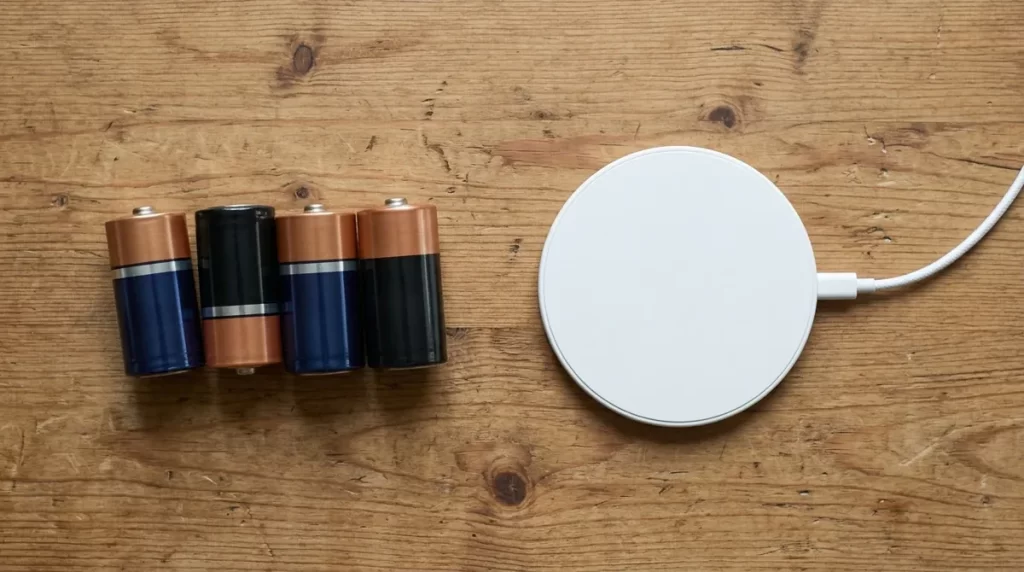
The cat has the simplest routine possible: switch on and replace four C batteries when it slows down. That suits someone who will not remember to charge anything, or a care home where staff can swap batteries.
Moflin runs about 5 hours per charge at room temperature and recharges in about 3.5 hours on its wireless Moflin Bed. The natural routine is evening use and overnight charging. Casio recommends charging at least once every six months even in storage. That is easy for most adults, but it is one more task for a person with memory difficulties.
Privacy
Both are among the most private robot companions available. The Joy for All cat has no connectivity at all. Moflin has no camera; Casio says it does not understand or record speech, processes data locally, and uploads data only through the optional app when you choose to. See our Moflin review for Casio’s full data statements.
Cleaning and shared use
Ageless Innovation gives detailed instructions for shared settings: spray the fur with a non-toxic toy cleaner or wipe it with a germicidal wipe, brush it, and have users wash hands before and after. Casio recommends gently brushing Moflin and wiping dirt with a damp cloth. Neither can be soaked. In a care home with several residents, the Joy for All cat’s cleaning protocol and lower price make it easier to manage.
Which one to choose
Choose the Joy for All cat if
- The person loved cats or misses a pet
- Nothing should need charging or setup
- It will be shared or used in a care setting
- Budget is under $200
Choose Moflin if
- The person enjoys novelty and gradual change
- A small, light companion is easier to hold
- Someone will manage charging
- An optional app and journal add interest
Neither is a treatment for loneliness or dementia, and both work best alongside human contact. Our full Joy for All review and the seniors guide cover how to introduce a robot pet respectfully.
Frequently asked questions
Is Moflin worth more than twice the price of a Joy for All cat?
Only if adaptive behavior and a developing personality matter to the person. For familiarity and simplicity, the cat offers more for less.
Which is better for someone with dementia?
Caregivers often prefer the Joy for All cat because it is familiar and needs no charging, but every person reacts differently. Involve the care team and watch for distress as well as comfort.
Do either need Wi-Fi?
No. The cat has no connectivity; Moflin’s app is optional and connects over Bluetooth.
Which is lighter?
Moflin, at about 260 g, against 3.9 lb for the cat.
Sources and update policy
Casio Moflin (US), Casio Moflin manual and Joy for All Companion Cat, checked October 12, 2026.