Independent buying guide · Fact-checked July 13, 2026
The best robot for an older adult depends on the job it needs to do
A conversational companion, a responsive robotic pet and a clinical therapeutic robot are not interchangeable. This guide compares three real options, explains what current evidence can support and gives families a practical way to test accessibility, privacy, cost and safety before committing.
$159.99 to quoteVery different ownership models
Human-led careSupport, never replacement
Quick answer
Three defensible options for three different needs
Start with the older adult’s goal and preferences. “Best” means the product is usable, wanted and safe in that person’s home—not that it has the longest feature list.
ElliQ
Choose it for voice-led conversation, wellness activities, reminders and family connection when reliable Wi-Fi and a continuing lease membership are acceptable.
- Current entry cost
- $249 initiation + membership
- Internet
- Required
- Best setting
- Independent home use
Joy for All Companion Cat
Choose it for tactile, pet-like interaction without an account, screen, Wi-Fi or subscription. It is entertainment and comfort, not monitoring or open-ended conversation.
- Current price
- $159.99
- Internet
- Not required
- Best setting
- Home or supervised care
PARO
Consider it through a clinician or care organization for structured therapeutic activity, particularly in dementia care. It is a specialist product sold through regional channels.
- Current price
- Request a regional quote
- Internet
- Not central to interaction
- Best setting
- Care program or clinician-led use
Side-by-side
Robot companions for seniors compared
| Option | Primary experience | Cost model | Camera / mic | Family connection | Main limit |
|---|---|---|---|---|---|
| ElliQ | Proactive conversation, activities and reminders | $249 lease initiation; $39–$59/month depending on plan | Touchscreen camera and microphones | Caregiver app, messages, photos and video calls | US-only service; Wi-Fi and membership required; no 911 |
| Joy for All Cat | Touch-responsive purring, meowing and movement | $159.99 purchase; four C batteries included | No connected camera or voice assistant | None built in | No reminders, calls, monitoring or true conversation |
| PARO | Responsive baby-seal interaction in a therapeutic context | Quote through regional distributor | Sound sensor plus tactile, light, temperature and posture sensors | None built in | Specialist cost and implementation; benefits are not guaranteed |
Current product sources: ElliQ membership offer, Joy for All Companion Cat, and PARO regional sales contacts. Confirm the checkout or written quote in your country.
Option 1
ElliQ: proactive conversation for independent living
US service
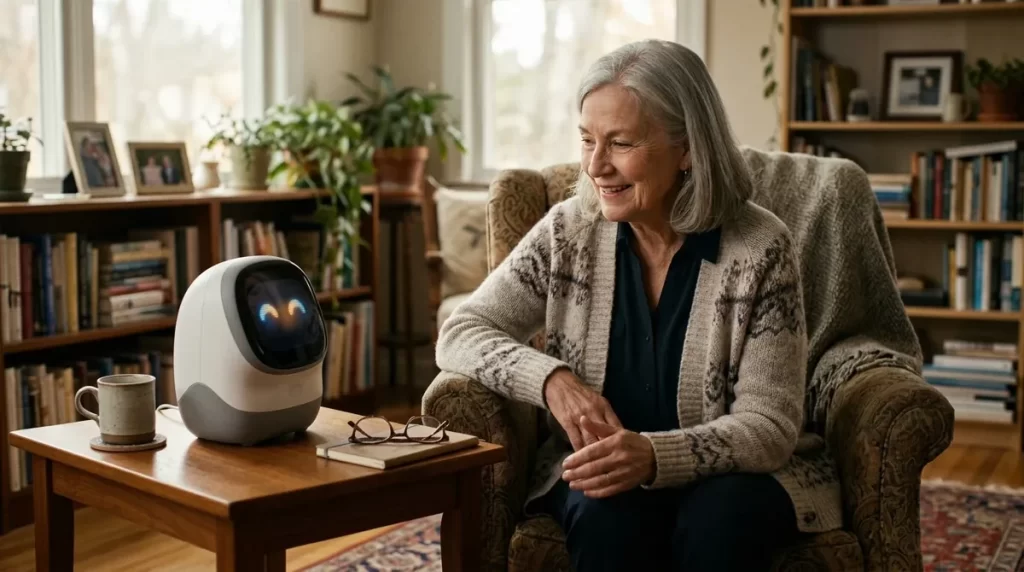
ElliQ combines a stationary expressive unit with a touchscreen, microphones, speakers and camera. It initiates conversation, offers games and wellness activities, provides reminders and can connect an older adult with approved family or caregiver contacts. Unlike a passive smart speaker, its central appeal is that it starts interactions.
The current consumer offer is a lease rather than hardware ownership. A one-time $249 initiation fee is charged with membership. The 24-month option is $39 per month billed as $936 upfront; the annual option is $49 per month billed as $588 upfront; and the monthly option is $59. The 24-month and annual plans advertise a 30-day trial. ElliQ must be returned when membership ends.
Strong reasons to consider it
- Designed around older-adult voice and screen interaction.
- Proactive prompts may help a person who will not open an app independently.
- Activities, reminders and simple family communication share one interface.
- Setup support, updates, warranty and caregiver app are included during membership.
Reasons it may be wrong
- It requires reliable electricity, Wi-Fi and an ongoing paid service.
- The device is leased and currently supported only in the United States.
- Voice, camera, preferences and wellness information create privacy decisions.
- It cannot contact 911 and is not an emergency or life-saving service.
Evidence in context: A February 2026 New York State program report describes 834 participants, 41 average daily interactions, 94% of responding clients saying they felt less lonely and 97% reporting they felt better overall. Those results are encouraging, but the report reflects a selected public program, self-reported outcomes and anonymized usage data; it was produced with the manufacturer and was not a randomized comparison.
Our verdict: ElliQ is the best current home option here when an older adult wants regular conversation and family features, can consent to connected data use and will genuinely use it. Read our full ElliQ review for lease terms, privacy and feature-by-feature limitations.
Option 2
Joy for All Companion Cat: low-complexity, tactile comfort
No Wi-Fi
Joy for All’s robotic cat responds to touch with purring, meowing, head movement and rolling behavior. The official store currently lists each color at $159.99. It weighs 3.9 pounds, runs on four included C batteries and has no account or subscription. That simplicity is the point.
This product suits someone who enjoys animals but cannot manage feeding, veterinary care, allergies or the physical demands of a live pet. It can also offer a shared activity for a family member or care worker. However, it does not understand conversation, verify medication, detect a fall, call anyone or learn a care routine.
Strong reasons to consider it
- No Wi-Fi, account, cloud service or monthly payment.
- Direct touch produces an immediate and understandable response.
- Few controls and no screen reduce setup burden.
- Lower cost makes a supervised trial more practical.
Reasons it may be wrong
- Some adults may find a robotic pet childish or unwanted.
- Motor sounds, repetitive behavior or fur texture can be irritating.
- Batteries and cleaning still require a responsible person.
- Manufacturer wellbeing claims should not be treated as guaranteed treatment effects.
Our verdict: This is the most accessible first experiment for pet-like comfort and shared engagement, provided the older adult likes it. Do not deceive a person with cognitive impairment about whether it is alive; introduce it respectfully and stop if it causes fear, anger or distress.
Option 3
PARO: a specialist therapeutic robot, not a casual gadget
Professional route
PARO is shaped like a baby harp seal and reacts through tactile, light, sound, temperature and posture sensors. It can orient toward a voice, respond to touch and develop different behavior patterns. Its unusual animal form avoids direct comparison with a household pet a person may have known.
PARO is sold through regional distributors rather than a normal consumer checkout, so request a current written quote, training details, warranty and service plan. Its strongest case is structured use in care organizations or with professional guidance, not an impulse purchase for an older relative.
A 2023 systematic review and meta-analysis included 12 articles and 1,461 participants aged 60 or older with dementia. It reported small pooled effects for anxiety, agitation and depression, but graded evidence for all outcomes as low. A large cluster trial found advantages over usual care on several observed measures, while comparison with a similar plush toy narrowed the advantage mainly to engagement. This is promising supportive-care evidence, not proof of a cure or benefit for every person.
Our verdict: Explore PARO when a clinician, activity professional or care organization has a defined objective, a way to document response and a plan to stop if the person dislikes it. See our companion robot research review for the underlying trials.
Decision framework
Choose by unmet need, not by the word “senior”
Needs proactive interaction?
Test ElliQ if the person enjoys voice interaction and can manage its connected service. Also ask whether scheduled human calls or community programs would better meet the need.
Responds well to animals and touch?
Try Joy for All or a professionally facilitated PARO session. Preference matters more than a dementia label.
Needs fall or emergency response?
Buy a dedicated medical alert system or wearable evaluated for that job. Do not infer emergency capability from reminders or a caregiver app.
Needs hands-on physical assistance?
These three products do not lift, transfer, bathe, cook, retrieve objects or manage mobility. Consider home-care and assistive-technology assessment.
Needs dementia support?
Coordinate with the care team. A robot may support engagement or routine, but it does not diagnose, slow or treat dementia on its own.
Needs more contact with people?
Prioritize family, friends, senior centers, visitor programs and transport. Technology is strongest when it helps sustain human contact.
Accessibility before features
Eight fit checks to perform with the older adult
- 01
Hearing
Can speech be understood at a comfortable volume without distortion? Test hearing aids and background noise in the actual room.
- 02
Vision
Check text size, contrast, glare, color dependence and whether essential functions work without reading a small screen.
- 03
Speech recognition
Test the person’s natural accent, volume and pacing. A device that repeatedly fails can frustrate or exclude the intended user.
- 04
Dexterity
Buttons, touch targets, charging plugs and battery covers must work with the person’s grip, tremor or arthritis.
- 05
Cognition
Observe whether prompts are clear and whether the product creates confusion, pressure, fear or an unhealthy expectation that it is human.
- 06
Mobility and placement
Keep cables, stands and moving objects out of walkways. The device should be reachable without bending, stretching or carrying it unsafely.
- 07
Language and culture
Confirm supported language, familiar activities and respectful forms of address. “Easy to use” is not universal.
- 08
Support person
Assign someone who can manage accounts, updates, billing and troubleshooting without taking control away from the older adult.
Evidence without hype
What companion robots may help—and what remains uncertain
Engagement and activity
Responsive robots can create a focus for conversation, touch, play and facilitated group activity. This is one of the more consistent practical uses.
Some loneliness outcomes
Home programs and trials report encouraging results, especially when the device prompts activity or enables contact with other people.
Mood and agitation
Some PARO studies report small benefits, but results vary by outcome, comparator, setting and facilitation.
Long-term cognition
There is not strong evidence that a consumer companion robot prevents cognitive decline or changes the course of dementia.
Replacing care
Research generally evaluates robots as additions to care or activities, not substitutes for human support, clinical judgment or emergency services.
Health monitoring
Wellness check-ins and reminders are not the same as validated vital-sign measurement, diagnosis or regulated remote monitoring.
For a transparent breakdown of study design and limitations, use our robot companion therapy guide and research review rather than relying on manufacturer percentages alone.
Consent and data
Caregiver access should not erase the older adult’s privacy
A connected companion may process voice, video, contact lists, preferences, reminders, activity and wellness information. The older adult should understand what the robot does, choose who receives updates and be able to change that decision. Cognitive impairment makes respectful, least-intrusive defaults more important—not less.
- What is recorded, transcribed or inferred?
- What stays on the device and what reaches the cloud?
- Is information used to train AI systems?
- Which employees and service providers can access it?
- How long is each data type retained?
- Can the user export and permanently delete it?
- Who owns and administers the account?
- Which contacts can call, view or receive alerts?
- When is camera or microphone access permitted?
- Which reminders are helpful versus intrusive?
- How will consent be revisited?
- Who handles a breach or account compromise?
Aging in place safely
Build an emergency plan that still works when the robot does not
Power, Wi-Fi, cloud services, microphones and accounts can fail. The National Institute on Aging recommends considering a dedicated medical alert system for urgent situations. Keep that pathway separate from a social robot unless a specific regulated product and service contract explicitly cover it.
A reachable phone, wearable or monitored medical alert appropriate to the person’s needs.
Charged backup devices, written contacts and a plan that does not depend on Wi-Fi.
A clinician-approved routine and purpose-built organizer or dispenser where needed.
Home hazard assessment, appropriate mobility support and a tested way to summon help.
A clear schedule, escalation contact and action if the person cannot be reached.
Support number, account details and a simple fallback for every essential function.
Reference: National Institute on Aging guidance for aging in place.
Cost and funding
Calculate the full commitment before relying on a grant or insurance
Do not assume Medicare, Medicaid, long-term care insurance, a health savings account or veterans benefits will reimburse a robot. Coverage depends on the product, medical necessity, plan, provider, coding and jurisdiction. Get written confirmation from the payer before purchase.
Price the complete termInclude initiation, prepaid membership, shipping, tax, batteries, accessories and return charges.
Ask local aging servicesArea Agencies on Aging may know about pilots, lending libraries, grants or lower-cost human programs.
Get coverage in writingA salesperson’s suggestion is not an insurance authorization or tax determination.
Plan the exitKnow cancellation, return, data deletion and what stops working when service ends.
Use our ownership cost calculator to model several years and the complete buying guide to review warranties, support and return terms.
Respectful evaluation
A seven-day home trial protocol
Consent and baseline
Agree on the goal in the older adult’s own words. Note the current routine so novelty is not mistaken for lasting value.
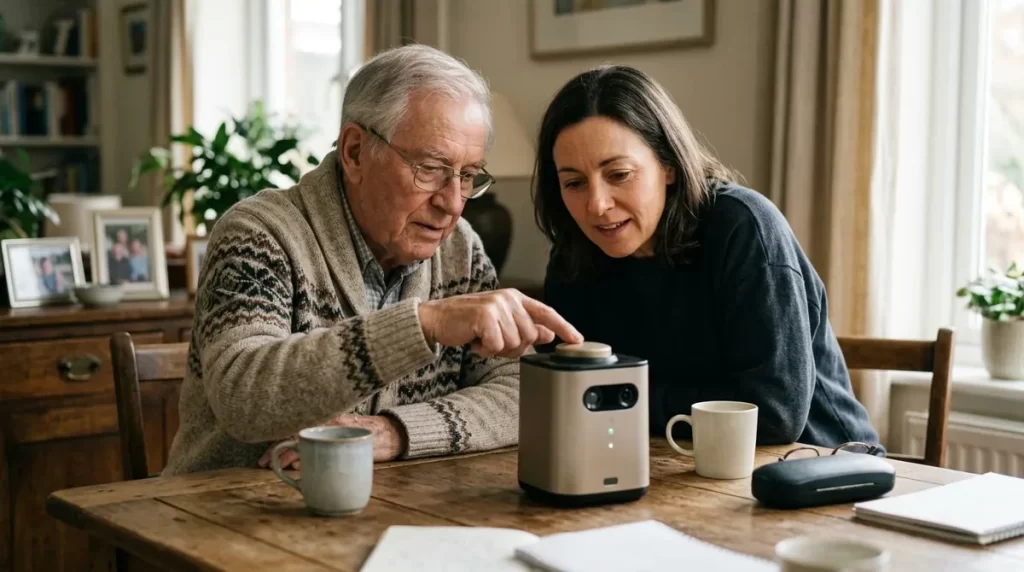
Set up together
Use a shared room, minimum permissions and comfortable volume. Demonstrate mute, stop and power controls.
Observe natural use
Do not force interaction. Record successful and failed commands, confusion, enjoyment and support required.
Test the real routine
Try intended activities, family communication and reminders. Confirm that emergency fallbacks remain reachable.
Review privacy and cost
Check activity history, permissions, subscription, return deadline and how to delete the account.
Let the user decide
Keep it only if the older adult wants it, can use it with reasonable support and the original goal is measurably better served.
Avoid expensive mistakes
Seven red flags in senior-robot marketing
- “Clinically proven” without naming the exact product, study, outcome and comparison.
- A loneliness percentage presented as if it applies to every user and setting.
- Medication “management” that is only an unverified reminder.
- Fall detection, vital signs or emergency calling implied but absent from official specifications.
- “HIPAA compliant” used without explaining the vendor’s legal role and data flows.
- Pressure to buy for an older adult who has not tried or requested the product.
- A concept robot, marketplace listing or discontinued model presented as supported retail hardware.
We excluded Samsung Ballie and TCL Ai Me from the recommendations because we could not verify a current supported consumer checkout with complete ownership and service terms. A demonstration or announcement is not enough for a responsible buying guide.
Common questions
Robot companions for seniors FAQ
What is the best robot companion for an older adult living alone?
ElliQ is the strongest current option for proactive home conversation and family connection, provided the person wants it, lives in the United States, has reliable Wi-Fi and accepts the lease membership. It is not an emergency service.
Is there a robot companion for seniors without Wi-Fi?
Yes. The Joy for All Companion Cat works with four C batteries and does not require an internet account. PARO’s core responsive interaction is also not based on a consumer cloud conversation service, but it is a specialist therapeutic product.
Can a robot detect falls and call 911?
Do not assume so. The three products compared here are not substitutes for a dedicated, monitored medical alert system. ElliQ’s terms explicitly state that it cannot contact 911.
Are robot companions good for dementia?
Some studies of PARO and other responsive robots report improvements in engagement and selected behavioral outcomes, but evidence quality is often low and responses vary. Use should be individualized, respectful and supplementary to care.
Will Medicare pay for a companion robot?
There is no general promise that Medicare will pay for a consumer companion robot. Ask the plan and treating provider about the exact device and obtain a written coverage determination before purchase.
Bottom line
The right robot adds a wanted activity without weakening real care
Choose ElliQ for proactive connected conversation, Joy for All for simple pet-like comfort, or explore PARO through a professional therapeutic program. If the actual need is emergency response, fall protection, medication dispensing or hands-on assistance, buy and organize those services directly.
The older adult remains the decision-maker wherever possible. A successful companion robot should support autonomy and human connection—not become a reason to visit less, listen less or monitor more than the person has agreed to.