Evidence and care-planning guide · Updated July 13, 2026
A robot can support an activity; it cannot carry the care plan
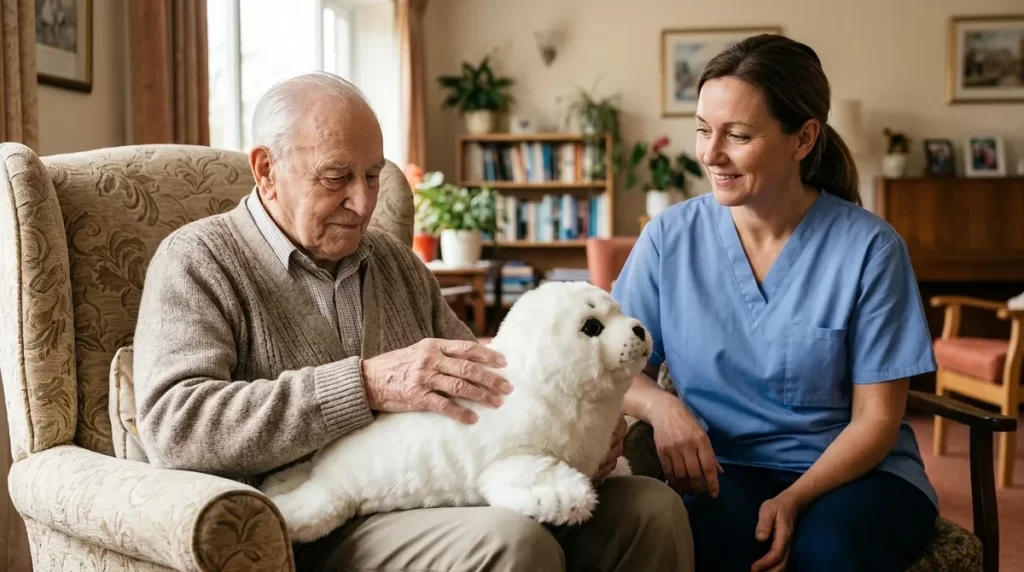
For some people living with Alzheimer’s disease or another dementia, an interactive pet or social robot can invite touch, conversation, music or shared attention. The best evidence suggests modest benefits for selected behavioral or emotional outcomes in structured programs—not restored memory, independent safety monitoring or replacement of caregivers.
3 intervention formatsNot a universal product ranking
6-week trial planGoals, measures and stop rules
Start with the person
Dementia care is not a technology problem
Dementia is a syndrome caused by several diseases; Alzheimer’s disease is the most common cause, but people differ in diagnosis, stage, communication, mobility, sensory ability, culture, history and what brings comfort or distress. A robot should therefore be considered only as one optional activity inside a person-centered health and social care plan.
The World Health Organization states that there is no cure for dementia, while much can be done to support quality of life, activity, social interaction and daily function. NICE guidance similarly recommends a range of wellbeing activities tailored to the person’s preferences. Neither principle makes a robot necessary: music, conversation, gardening, walking, art, reminiscence, a real animal or another familiar activity may be more acceptable and less burdensome.
Person before product
Begin with the person’s history, present preferences, abilities and care goals—not a robot demonstration.
Invitation, not imposition
Offer the interaction and observe verbal and nonverbal response. Refusal, avoidance or distress ends the session.
One defined purpose
Choose a measurable goal such as shared engagement during a difficult transition, not “improve dementia.”
Human facilitation
A caregiver or professional introduces, interprets and adapts the activity rather than leaving the person alone with it.
Least intrusive option
Prefer the simplest device and smallest data collection that can support the chosen experience.
Review and exit
Continue only while benefit exceeds distress, workload, privacy risk and cost. Stop without framing it as failure.
What research supports
Evidence shows small signals and important uncertainty
Social-robot research in dementia includes different products, settings, diagnoses, session lengths, facilitators, control groups and outcome scales. That heterogeneity matters. A positive average effect does not tell us that every robot helps every person or that an unsupervised home purchase reproduces a staff-led research protocol.
14 randomized studies reviewed
Ten studies entered the pooled analysis. AI-based socially assistive robots were associated with small reductions in depressive symptoms and agitation. No statistically significant effect was found for cognition or anxiety.
15 trials, 705 participants
This review reported reductions in agitation and anxiety, but no significant effect on cognition, neuropsychiatric symptoms overall, depression, quality of life, daytime steps or hours lying down at night.
Mixed results and moderate study quality
Sixteen studies showed beneficial, non-beneficial and mixed outcomes. Reporting and intervention differences made generalization difficult; cognition was predominantly not improved.
| Outcome | Current interpretation | What to measure locally | Do not claim |
|---|---|---|---|
| Engagement | Some people interact, talk or attend during structured sessions. | Minutes voluntarily engaged, verbal initiation, shared attention | Guaranteed social connection or long-term transfer |
| Agitation | Several analyses report reduction, but methods and results differ. | Frequency, intensity, antecedent and recovery for a defined situation | That a robot treats every cause of agitation |
| Depression or anxiety | Different recent meta-analyses reach different outcome-specific conclusions. | Clinician-selected measure plus distress and acceptability | Diagnosis, psychotherapy or medication replacement |
| Cognition or memory | Recent pooled analyses did not show significant cognitive benefit. | Functional goal chosen by the care team, not a promised memory gain | Slowed disease, restored memory or prevention of decline |
| Quality of life | Evidence varies by review, instrument and intervention. | Person/carer-reported enjoyment, comfort, participation and burden | Global improvement from device ownership alone |
| Safety and independence | Social-robot trials are not proof of fall, wandering or emergency protection. | Keep independent safeguards and supervised care plan | 24/7 monitoring or caregiver replacement |
For a broader explanation of study design, controls and clinical claims, see our companion robot research and clinical trials guide.
Appropriate role
Six uses worth testing as supported activities
Each use below assumes supervision, an individualized goal and a simpler alternative. The robot is the medium for an activity; it is not the clinician, decision-maker or responsible caregiver.
Shared attention
A tactile or expressive robot may give two people something concrete to notice, hold and talk about.
Measure:voluntary attention, conversation turns and visible comfort during a defined session.
Pleasant sensory activity
Soft texture, gentle movement or predictable sound may support a calm, enjoyable period for someone who welcomes it.
Measure:acceptance, relaxation cues, distress and the amount of facilitation required.
Reminiscence prompt
A robot pet, photo, music or familiar phrase can open conversation about animals, family, work or earlier routines.
Measure:interest and meaningful expression, not factual memory accuracy.
Transition support
A familiar brief activity may help before meals, personal care, family calls or a shift change when the person finds transitions difficult.
Measure:distress before and after, transition completion and whether another activity works as well.
Group participation
Staff can use a robot within a small group to encourage turn-taking, observation, music or storytelling.
Measure:participation across members, inclusion and staff burden—not only the most responsive participant.
Remote connection aid
A stationary social device may make family calls or messages easier when the person understands and accepts the workflow.
Measure:successful contact, frustration, privacy and whether human connection increases rather than decreases.
Hard boundaries
What a companion robot must not be asked to do
It cannot determine Alzheimer’s disease, stage dementia, explain a sudden change or interpret pain reliably.
It does not replace prescribed medicine, occupational therapy, cognitive stimulation therapy or clinical review.
Consumer companion products are not automatically fall detectors, medical alarms, 911 systems or life-safety devices.
A mobile robot cannot supervise exits or replace identification, environmental safeguards and a missing-person plan.
A spoken reminder does not verify the right person, medicine, dose, timing or swallowing.
Battery, Wi-Fi, cloud, sensors and accounts fail. Necessary human observation cannot be delegated to a friendly interface.
A family purchase or administrator account does not erase the person’s right to assent, refuse or have privacy.
A robot should not justify fewer wanted visits, activities, staff interactions or community connections.
Stage and fit
Adapt complexity to current ability, not a label alone
Dementia progression is not uniform. Hearing, sight, language, mobility, fatigue, pain, medication and environment can matter as much as a stage label. Reassess after illness, hospitalization, move, bereavement or medication change.
Collaborative choice
- Discuss purpose, privacy, cost and what the robot is.
- Let the person compare it with simpler activities.
- Use reminders only as cues, with verification for important tasks.
- Record future preferences before communication becomes harder.
Short, familiar sessions
- Reduce menus, commands and competing noise.
- Use one facilitator and one activity goal.
- Offer at predictable times without forcing routine.
- Watch nonverbal assent, fatigue and overstimulation.
Sensory comfort and presence
- Prefer gentle, simple, closely supervised interaction.
- Avoid expectations of learning or independent operation.
- Prioritize positioning, skin, infection control and rest.
- Stop immediately for withdrawal, guarding, startle or distress.
The National Institute on Aging advises patient communication: use the person’s name, make eye contact, allow extra response time, avoid arguing and do not talk about the person as if they are absent. The same standards apply when a robot is in the room. See the NIA communication guidance.
Format comparison
Choose by intervention burden, not “smartest AI”
The products below illustrate distinct formats; they are not interchangeable and this is not a clinical endorsement. Availability, pricing and service terms change. Confirm infection-control, training, return and support requirements in the intended setting.
| Example | Interaction model | Potential fit | Burden and limits | Data intensity |
|---|---|---|---|---|
| PARO therapeutic seal | Tactile animal-like robot with responsive movement and sound | Staff-facilitated sensory or social activity; strongest direct research history in dementia robotics | Specialized acquisition, training, cleaning and protocol; not monitoring, emergency response or independent treatment | Lower cloud emphasis; verify exact model and organizational policy |
| Joy for All companion pet | Battery-powered animatronic cat, dog or bird responding to touch or sound | Lower-complexity home or care-setting activity when the person likes the form | Consumer product, not a care system; batteries, synthetic fur, shared-use cleaning and possible misidentification | No account or Wi-Fi needed for core pet interaction |
| ElliQ | Stationary conversational device with screen, proactive prompts and family connection | Earlier-stage user who can understand voice interaction, subscription and contact sharing | Requires power, Wi-Fi and US-supported membership; manufacturer states it is not an emergency device | Connected account, microphones, cameras and optional family sharing require privacy review |
| Generic telepresence robot | Remote video, audio and sometimes mobile navigation | Facilitated family or professional contact in a suitable environment | Can confuse or startle; fall, collision, privacy and remote-control risks; requires a human caller | High: live audio/video, contacts, accounts and network access |
PARO: evidence does not remove the need for protocol
A 2024 randomized trial studied group PARO sessions in adults with mild dementia, while other trials and reviews use different formats. Research delivery typically includes trained facilitators, defined session length and outcome measurement. Buying the device alone does not reproduce the intervention.
Joy for All: simpler can be more usable
The manufacturer describes touch- and sound-responsive animatronic pets powered by replaceable batteries. Simplicity reduces account and cloud burden, but the pet still needs individual acceptance, battery safety, cleaning and a plan for shared use.
ElliQ: connection support, not Alzheimer’s monitoring
There is no special “Alzheimer’s Edition” in the current consumer offer. ElliQ may support activities and family communication for selected US users, but its FAQ explicitly says it is not an emergency device. Do not infer fall detection or 24/7 safety protection.

Implementation
Run a six-week care-plan trial before committing
A trial should answer whether this specific activity helps this person in this setting. For a care home or clinical service, obtain organizational approval, infection-control review, staff training and documentation rules. At home, involve the person, care partner and relevant clinician when symptoms, risk or treatment goals are involved.
Define
Choose one situation, observable goal, baseline, facilitator, comparison activity and stop rule.
Introduce
Offer two or three short sessions at calm times. Learn preferred distance, name, sound and handling.
Stabilize
Keep session timing and facilitation similar. Record response, distress and workload consistently.
Compare
Compare with the baseline and a simpler familiar activity rather than with no attention at all.
Decide
Continue, adapt or stop based on benefit, person preference, burden, privacy and cost.
Turn “reduce agitation” into a testable care goal
Session protocol
Ten steps for a respectful facilitated session
- 1
Check current condition.
Do not begin during new illness, pain, marked fatigue, escalating distress, urgent care needs or an unsafe environment.
- 2
Prepare the device.
Confirm charge, cleanliness, volume, privacy settings and safe placement before the person enters or receives it.
- 3
Reduce competing stimulation.
Lower background noise, provide good lighting and remove trip hazards or unnecessary screens.
- 4
Ask and show.
Offer the robot at a comfortable distance, explain simply what it is and ask whether the person would like to interact.
- 5
Wait.
Allow extra processing time. Do not place a robot on someone’s lap or startle them with movement.
- 6
Follow the person’s lead.
Touch, talk, observe or decline are all valid responses. Avoid testing memory or correcting personal interpretation.
- 7
Facilitate human connection.
Use the activity to listen, converse and share; do not withdraw because the device is holding attention.
- 8
Watch assent continuously.
Notice pushing away, freezing, guarding, grimacing, calling out, withdrawal, fixation or attempts to leave.
- 9
Close predictably.
Give a simple ending cue and transition to the next familiar activity without taking the robot abruptly.
- 10
Document briefly.
Record context, duration, response, distress, facilitator time and whether the agreed goal was observed.
Risks and safeguards
Screen eight risks before every implementation
Fear, grief or fixation
Animal-like motion or disappearance after a session can distress someone. Introduce gradually, maintain predictable access and stop when distress outweighs enjoyment.
Misidentification or deception
Do not insist the robot is alive or ridicule the person’s interpretation. Use transparent, respectful language and prioritize felt safety over correction.
Falls, weight and movement
Cables, docks, mobile bases and reaching can create hazards. Assess seating, transfer, grip, pathways and supervision.
Masking pain or delirium
A temporary calming response does not explain new distress. NICE recommends assessing clinical and environmental causes before intervention.
Shared tactile surfaces
Use a documented cleaning protocol compatible with the product and setting. Consider individual assignment when safe disinfection is limited.
Audio, video and caregiver data
Minimize sensors, accounts, history and sharing. Everyone in the room may be captured, not only the registered user.
Reduced human contact
Track whether visits, staff time and preferred activities remain available. Automation should not become a staffing substitute.
Cost, support and removal
Plan battery, cleaning, subscription, repair, data deletion and what happens if the person no longer wants the robot.
For account permissions, cameras, microphones and incident response, continue with the robot companion security and privacy guide. For consent, emotional influence and human relationships, see our robot companion ethics guide.
Outcome review
Measure benefit, burden and adverse effects together
A successful activity should not be judged only by whether the person touched the robot. Use a small, consistent record that captures both positive and negative responses. Clinical scales should be selected and interpreted by qualified professionals.
- Accepted, declined or tolerated
- Visible pleasure, calm or interest
- Fear, frustration, fixation or fatigue
- Verbal and nonverbal choice
- Target situation and baseline
- Duration of voluntary engagement
- Frequency or intensity of defined behavior
- Transition or communication outcome
- Preparation and facilitation minutes
- Training and cleaning burden
- Whether human interaction increased
- Observed benefit and concern
- Reliability and charging
- Privacy or access incident
- Subscription and repair cost
- Use across people and infection control
Repeated voluntary benefit, minimal distress, manageable workload and no better simpler option for the same goal.
Some benefit but timing, volume, facilitator, session length, product form or privacy setting needs adjustment.
Fear, avoidance, fixation, physical risk, privacy concern, no meaningful benefit, excessive burden or person/family request.
Print or save
24-point dementia robot trial checklist
Common questions
Robot companions and dementia FAQ
Can a robot companion help someone with Alzheimer’s disease?
It may support a pleasant, structured activity for a person who accepts it. Research shows small signals for outcomes such as agitation or depressive symptoms in some pooled analyses, but results vary and cognition has not shown reliable improvement. The robot should be tested inside a person-centered care plan.
Can a robot companion improve memory or slow Alzheimer’s?
Current evidence does not establish restored memory, slowed disease progression or cognitive improvement from companion robots. Reminiscence conversation may be enjoyable without improving factual recall. Continue evidence-based medical and social care directed by qualified professionals.
Which robot is best for dementia care?
There is no universal best. PARO has the strongest direct research history as a facilitated therapeutic robot; Joy for All pets offer simpler low-connectivity interaction; ElliQ offers connected conversation and family features for selected US users. Fit depends on the person, goal, setting, facilitation, privacy, infection control and budget.
Can a robot prevent wandering or detect falls?
Do not assume so. A companion robot is not automatically a validated fall detector, medical alarm or wandering-prevention system. Use independent safeguards, identification, environmental controls and emergency plans recommended by the person’s clinical and local support team.
Is it ethical if the person thinks the robot is alive?
Do not deliberately deceive or ridicule. Explain simply, follow the person’s emotional response and avoid repeatedly correcting in a way that causes distress. The person retains the right to refuse, and caregivers should monitor attachment, grief, dignity and whether human relationships are protected.
How long should a robot session last?
There is no fixed duration. Begin with a few minutes, stop while the experience remains positive and increase only if the person continues to choose it without fatigue or distress. Research protocols cannot be copied blindly to an individual home or care setting.
What should caregivers do if agitation suddenly increases?
Pause the robot and assess safety. Sudden or marked behavior change may reflect pain, delirium, infection, medication effects, hunger, thirst, toileting needs, sleep disruption or environmental stress. NICE recommends structured assessment of clinical and environmental causes before non-drug or drug intervention.
Bottom line
Use the robot to deepen care, never to thin it out
A companion robot is most defensible when it supports a chosen, enjoyable activity; a person can assent or refuse; a human facilitates; a specific outcome is measured; and safety, privacy and human contact remain independent. The same device is inappropriate when it frightens, confuses, fixes attention, increases workload or becomes an excuse to reduce necessary care.
Choose the smallest intervention that meets the person’s goal, compare it with familiar alternatives and review it like any other part of the care plan. Dignity and relationship quality are not secondary outcomes—they are the standard by which the technology should be judged.