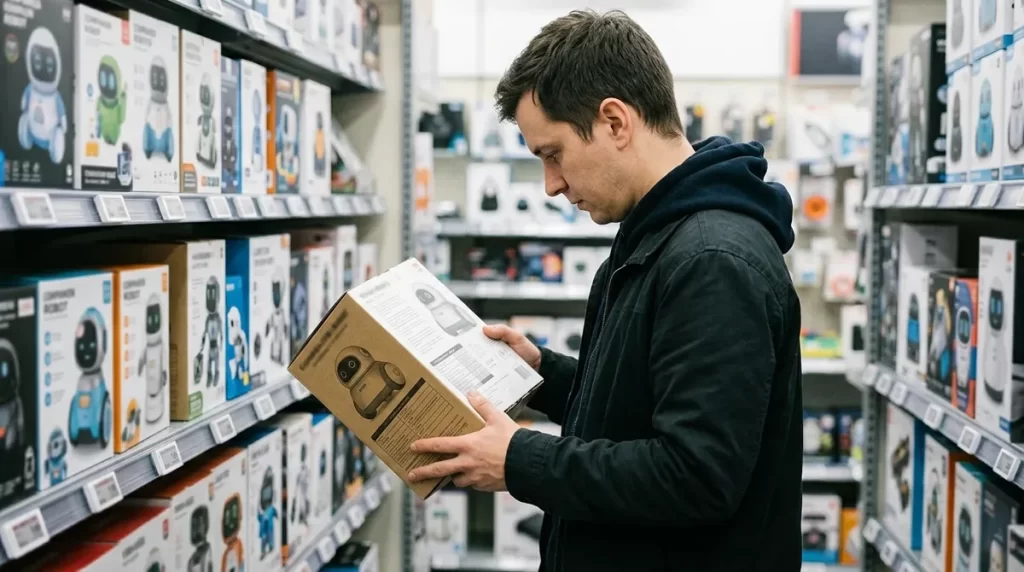
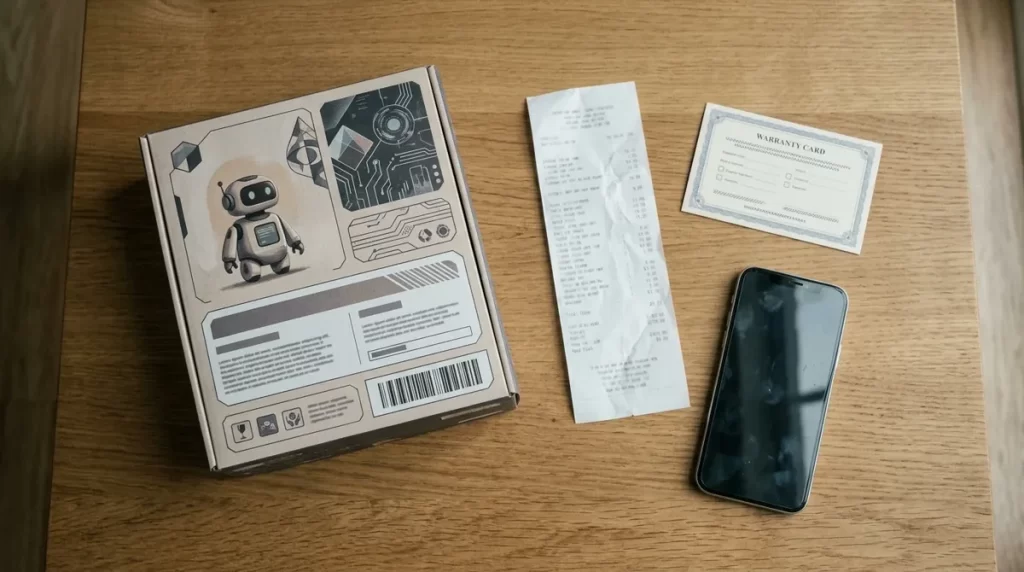
Illustrative image, not a photo of the product reviewed.
Independent buyer’s guide · Updated July 13, 2026
Buy the robot that works today—not the AI promise it may become
A companion robot can cost less than a phone or more than a car, yet price alone says little about fit. The useful questions are what the robot does now, who will use it, what data it collects, what stops working without a subscription and what happens when it needs service.
Start withone daily outcome
Comparethree-year cost
Verifyshipping and support
Testfit before commitment
12 checks to make before buying a robot companion
The safest buying process begins with the person and the environment, then narrows the technology. Complete these checks in order. A product that fails a deal-breaker should leave the shortlist even if its demonstration is impressive.
Define one primary outcomeWrite the most important daily job in one sentence: playful pet-like interaction, conversation, routine prompts, telepresence, supervised learning or structured care engagement.
Name the actual userConsider age, hearing, vision, speech, dexterity, cognitive load, technical confidence and whether another person will manage the account.
Map the physical settingCheck desk space, floor transitions, stairs, pets, children, noise, Wi-Fi coverage, charging access and safe storage.
Separate must-haves from noveltyChoose no more than three essential capabilities. Lights, dances and generated jokes should not outweigh accessibility or reliability.
Watch an unedited demonstrationLook for startup, normal conversation latency, movement, charging, error recovery and the companion app—not only a polished promotional montage.
Confirm current product statusIdentify whether it is shipping, made to order, leased, preorder-only, a developer platform, a research prototype or merely announced.
Calculate three-year ownership costAdd required memberships, accessories, delivery, likely battery or wear costs and service shipping to the advertised hardware price.
Read the privacy policyDetermine what microphones, cameras and cloud services collect, how long data is retained, who can access it and how to delete the account.
Check what works offlineAsk what remains if Wi-Fi, a mobile app, a paid plan or the manufacturer’s cloud is unavailable.
Read return and warranty termsRecord the return clock, condition requirements, fees, exclusions, repair region and who pays insured shipping.
Verify the seller and payment routePrefer the manufacturer or an authorized dealer and use a payment method with appropriate purchase protections.
Plan the exitKnow how to factory-reset, deregister, transfer, recycle, return or safely resell the robot before it enters a private space.
The one-sentence test
If you cannot complete “We are buying this robot so that ___ can ___ each day,” the purchase is not ready.
Choose a robot companion by use case
Robot companions are not interchangeable. A mobile robotic pet, a stationary conversational device and a telepresence platform may all be called “companions,” but they solve different problems.
Play and character
Pet-like companionship
Prioritize autonomous behavior, expressive movement, touch response, repeatable activities and a design the user wants to live with.
Prioritize large controls, clear speech, caregiver permissions, simple setup and defined limits. A companion robot is not emergency monitoring unless explicitly certified and supported as such.
Accessibility is a buying criterion, not an accessory. Ask the intended user to try the voice, screen, app and physical interaction whenever possible. A family member’s enthusiasm does not prove that the device is usable by the person receiving it.
Calculate the true cost of a companion robot
Use a common time horizon so that a low entry fee with a required membership can be compared fairly with a higher one-time purchase. Three years is practical for comparison, but it is not a promise that any product or service will last that long.
Hardware or initiation+required plans+delivery and tax+accessories and service−guaranteed credits= 3-year cost
Current example
Pricing model
Cost question to ask
Why it matters
LivingAI EMO
US$279 for the standard package at review time
International delivery, return shipping and optional home station
A lower hardware price can still involve cross-border service friction.
ElliQ
US$249 initiation fee plus membership; device is leased
Exact plan, term, renewal, cancellation and return deadline
The device only works with an active membership and must be returned.
Sony aibo
US$3,199.99 with initial three-year AI Cloud Plan
Cloud renewal, accessories, repair and final-sale risk
Sony lists renewal at US$300/year after the included period.
LOVOT 3.0
¥577,500 plus service from ¥9,900/month in Japan
Regional eligibility, continuing plan and repair coverage
Three years at the minimum published plan totals ¥933,900 before extras.
Prices checked July 13, 2026 on official pages and shown only to illustrate different ownership models. Confirm the checkout, currency, tax, region and terms immediately before purchase. See our separate premium robot companion cost comparison for high-end options.
Required
Recurring service
Cloud processing, AI plan, membership, mobile connectivity or licensed content that the core experience needs.
Probable
Wear and maintenance
Batteries, moving joints, wheels, soft coverings, cleaning supplies, service labor and protected shipping.
Price increases, discontinued apps, unsupported hardware or features removed when cloud infrastructure changes.
Compare features that change the daily experience
Feature counts reward products for having more sensors or commands, even when those features do not improve the intended use. Score each category as essential, useful or irrelevant before comparing products.
01
Embodiment and touch
Is the physical form central to the experience? Check surface temperature, weight, noise, stability, pinch points, cleaning and whether touch meaningfully changes behavior.
02
Mobility and charging
Distinguish autonomous walking or driving from manual placement and remote control. Check runtime, docking success, thresholds, carpets, stairs and safe operating area.
03
Speech and hearing
Test accents, quiet voices, background television, hearing aids, command wording, interruption, response time and volume range in the real room.
04
Memory and personalization
Ask exactly what is remembered, where it is stored, whether users can inspect or delete it and what happens when accounts are transferred.
05
App and account dependence
Confirm supported phone operating systems, number of authorized users, remote permissions, accessibility, update frequency and whether setup can be completed without a smartphone.
06
Reliability and recovery
Look beyond the happy path. How does the robot signal lost Wi-Fi, a failed dock, a blocked joint, a depleted battery or a service outage?
A good home trial tests ordinary days.
Can the user start an interaction without help?
Does the robot understand them in the normal room?
Is charging reliable and physically manageable?
Does it remain engaging after repeated use?
Can errors be understood without technical support?
Verify whether the robot is actually available
A convincing video is not proof of a supported consumer product. Label every candidate with one of these statuses and apply the matching level of caution.
Lowest uncertainty
Shipping product
Current price, checkout, delivery estimate, warranty and support path are published. Still verify region and stock.
Contract review needed
Made to order or quote-only
Request a written specification, acceptance criteria, payment milestones, delivery terms, training and service agreement.
Higher uncertainty
Preorder or crowdfunding
Treat dates and planned features as uncertain. Read cancellation terms and never budget around an unshipped capability.
Not a purchase candidate
Prototype or concept
Research papers, trade-show demonstrations and announcements may be important, but they are not products households can buy and support.
Capability language matters.
“AI enabled” does not explain whether intelligence runs on the robot, in the seller’s cloud or through a third-party model. “Mobile” may mean autonomous navigation, a remote-controlled base or simply that a person can move the device.
Privacy and security questions for a robot in the home
A companion robot may occupy bedrooms, living rooms or care spaces and invite personal conversation. Treat its camera, microphone, account and app like a connected home system, not a toy with harmless data.
Collection
Which sensors record or stream?
Is there a visible listening or camera indicator?
Are conversations, faces, photos or room maps stored?
Processing
What runs locally and what goes to the cloud?
Which vendors or AI providers receive data?
Is data used to train models or personalize ads?
Control
Can recording features be disabled separately?
Can a guest interact without creating a profile?
Can stored history be viewed, exported and deleted?
Lifecycle
How long are security updates promised?
What works after service ends?
How is the robot reset before return or resale?
The US Federal Trade Commission recommends checking how long a smart device will receive software updates and considering what remains useful if updates stop. If the manufacturer does not publish an answer, ask support in writing before buying. Our robot companion privacy guide provides a deeper household checklist.
Illustrative image.
Returns, warranty and support: read the verbs, not the badges
“Risk free,” “covered” and “premium support” are marketing summaries. The binding terms explain whether you may return an opened robot, who pays freight, which country performs repairs and whether a membership period is refundable.
Return
Can you change your mind?
Check when the clock begins, whether setup counts as use, original-packaging requirements, return authorization, freight and restocking charges.
Warranty
What failures are covered?
Separate manufacturing defects from accidents, batteries, cosmetic wear, misuse, unauthorized repair and shipping damage.
Repair
Where does service happen?
Ask about regional eligibility, turnaround, diagnostic fees, replacement availability, data handling and shipping insurance.
Subscription
What happens after cancellation?
Confirm renewal cadence, notice deadline, remaining functionality, device ownership and any required return.
Example: LivingAI EMO
The official policy says eligible unused products may be returned within 14 days of delivery; consumer-caused returns carry return shipping. That is not the same as a two-week tryout.
Example: ElliQ
ElliQ is leased through a membership. Its FAQ lists a US$249 initiation fee and a 30-day trial on select plans; the terms govern eligibility, fees and return timing. Failure to return the device can trigger a US$1,500 fee.
Example: Sony aibo
The current US product listing marks aibo as final sale and non-returnable. That makes an in-person demonstration or extensive research especially valuable before purchase.
Keep screenshots or PDFs of the product page, warranty, return policy, promised ship date and order confirmation. The FTC advises checking availability, total cost and refund terms before ordering and preserving transaction records.
Where to buy a robot companion safely
Best default
Manufacturer
Provides the clearest product eligibility, account registration, warranty and current support path.
Good with verification
Authorized dealer
Confirm the seller on the manufacturer’s site and ask who owns warranty and return obligations.
Higher risk
Used marketplace
Proceed only if the account can be deregistered, service transfers, the region is supported and essential accessories are present.
Red flags that should stop the transaction
The price is dramatically below the manufacturer’s normal price without a verifiable explanation.
The seller accepts only gift cards, wire transfer, cryptocurrency or another difficult-to-dispute payment method.
The listing uses concept renders but provides no continuous footage of the exact hardware.
Warranty, returns, delivery date, company address or a working support channel cannot be found.
Planned features are described as current, or remote-controlled behavior is presented as autonomous.
The seller promises medical, emotional or caregiving outcomes without product-specific evidence and appropriate limitations.
For a used robot, request the serial number, proof of purchase, battery condition, repair history and a live reset demonstration. Contact the manufacturer before paying to verify whether ownership, subscriptions and regional service can transfer.
Robot companion shortlist worksheet
Use the same evidence for each candidate. A blank cell is not neutral; it is an unanswered purchase risk.
Decision field
Candidate A
Candidate B
Candidate C
Primary daily outcome
Three must-have features
Current product status
Three-year estimated cost
Offline capability
Privacy deal-breaker
Return window and fees
Repair region and shipping
What happens if service ends?
Evidence still missing
Intended user has participatedThe person who will live with the robot understands and accepts the interaction.
Current capability is sufficientThe decision does not depend on a future update, preorder promise or speculative intelligence.
Total cost is affordableRequired plans and realistic service costs fit the budget without counting hypothetical benefits.
Private spaces are consideredEveryone affected understands the sensors, accounts, controls and deletion process.
Exit route is documentedReturn, repair, cancellation, reset, transfer and recycling steps are known.
Frequently asked questions
How much should I spend on a robot companion?
Spend only after defining the outcome and verifying total ownership cost. Desktop character robots may start below US$300, while sophisticated robotic pets cost thousands and custom humanoids can exceed six figures. A higher price does not guarantee better companionship for a particular user.
Do companion robots work without a subscription?
Some do, some retain only limited functions and others require an active membership. Ask for a written list of offline features and what remains after cancellation. Do not assume that hardware ownership includes indefinite access to cloud AI.
Is a robot companion a good gift for an older adult?
Only when the recipient participates in the decision and can comfortably use it. Confirm setup, voice recognition, controls, privacy, Wi-Fi and who will manage support. A surprise device with cameras, recurring fees or complex account requirements may create more work than value.
Should I buy a companion robot used?
A used purchase can be reasonable if the seller proves ownership, factory reset and account deregistration, and the manufacturer confirms that service can transfer in your region. Battery condition, missing docks and non-transferable subscriptions can erase the apparent savings.
Are robot companions medical devices?
Most consumer companion robots are not medical devices and should not be treated as emergency services, diagnostic tools or replacements for professional care. Evaluate any health claim against the exact product’s regulatory status and evidence.
What is the biggest buying mistake?
Buying a future promise instead of a supported present-day experience. Product videos, generative AI language and planned features can create unrealistic expectations. Base the decision on demonstrations, written terms and functions available at checkout.
Sources and update policy
Commercial terms were checked July 13, 2026. Always review the current checkout and binding terms because prices, eligibility and policies can change without this article changing immediately.
Héctor Bravo is the founder and editor of Robot Companion AI. A long-time technology enthusiast with a particular interest in robots and artificial intelligence, he writes practical, sourced guides that help readers understand what companion robots can and cannot do before they buy.