Evidence-aware overview · Updated July 2026
The benefit comes from a well-matched activity—not from the robot alone
Companion robots can make routines visible, encourage participation, support communication and create enjoyable interaction. Results depend on the person, goal, environment, supervision and whether a simpler tool would work better.
Four ways a companion robot may create value
Embodied engagement
Movement, gaze, sound and touch can make an activity more noticeable or enjoyable than the same prompt on a screen.
Useful when participation—not information alone—is the barrier.
Repeatable structure
A robot can present the same cue, game or practice sequence consistently and at scheduled times.
Useful when predictability and repetition support the goal.
Social mediation
The robot can become a shared focus between a user, caregiver, teacher, clinician, family member or colleague.
Useful when it helps people interact with each other rather than replacing them.
Physical or remote presence
Some systems move through a space, manipulate objects or represent a remote person in another location.
Useful only when embodiment adds value beyond an app or video call.
These mechanisms explain why two robots with similar AI features can produce very different outcomes. Body design, control method, placement and social context matter.
Eight practical robot-companion use cases
Pet-like home companionship
Robotic pets can offer playful routines, touch, character and a sense of presence without feeding or outdoor exercise.
Measure:voluntary interaction, enjoyment and sustained use after novelty fades.
Older-adult activities
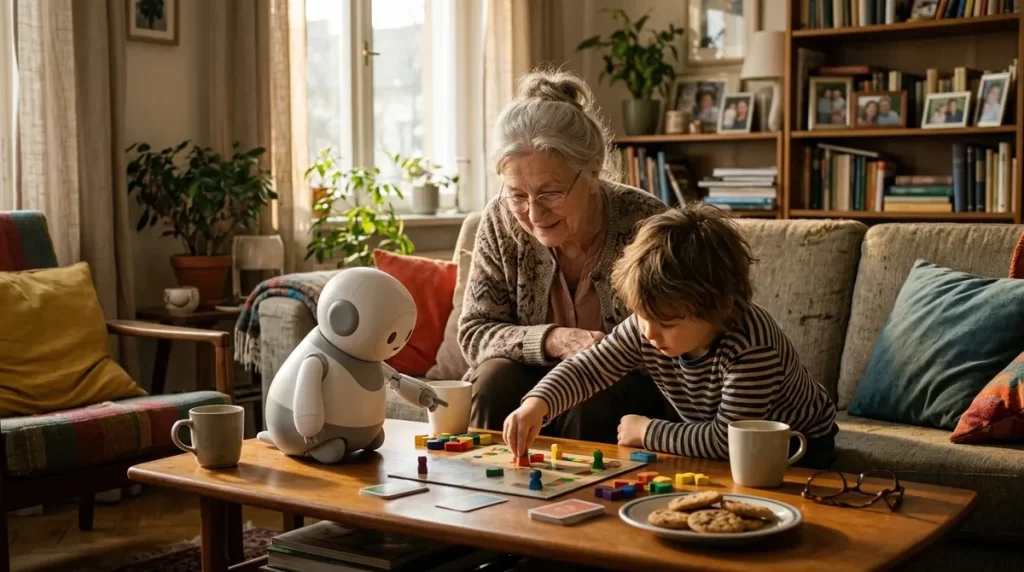
A social robot may lead conversation prompts, music, reminiscence, games or shared activities with family and staff.
Measure:participation, social interaction and staff facilitation time.
Structured autism support
Predictable robot-led activities can support selected joint-attention, turn-taking or social-communication goals in supervised programs.
Measure:the exact skill targeted and whether it transfers beyond robot sessions.
Therapy support
A clinician may incorporate a robot into a defined mental-health, communication, cognitive or rehabilitation activity.
Measure:clinical outcome chosen before the intervention, plus adverse effects and burden.
Disability and daily tasks
Assistive robotic arms, feeding systems or accessible controls may support a specific self-care or participation goal.
Measure:independent task completion, fatigue, errors and assistance required.
Routines and reminders
An embodied prompt may support hydration, appointments, activities or a sequence of daily steps.
Measure:confirmed completion—not merely whether the reminder was delivered.
Telepresence
A mobile screen can let a remote worker, student, specialist or family member control viewpoint and move within another site.
Measure:sessions where mobility improved access compared with standard video.
Education and exploration
Programmable robots can make coding, sensors, ethics and human-robot interaction tangible.
Measure:learning objective, accessibility, collaboration and retained understanding.
What the evidence supports
“Robot companions work” is too broad to evaluate. Research studies a particular robot, protocol, group, comparator, duration and outcome. A positive result in one combination should not be transferred automatically to another.
Robot-assisted rehabilitation for selected impairments
Large evidence syntheses cover upper- and lower-limb rehabilitation, especially after stroke. These are clinical devices and protocols, not ordinary companion robots.
Structured autism and social-communication activities
Controlled trials report benefits for some targeted activities, while outcomes depend on protocol, supervision and comparison treatment.
Social robots in dementia and wellbeing
Reviews report feasibility, acceptability and some positive experiences, but pooled effects on several clinical outcomes are inconsistent or limited.
Autonomous emotional and mental-health support
Trials are often small and interventions may be scripted or supervised. A friendly response is not proof of safe diagnosis, therapy or crisis care.
Potential benefits by user and setting
| User or setting | Potential benefit | Necessary condition |
|---|---|---|
| Household seeking a robotic pet | Play, routine, novelty and affectionate interaction | Expectations match the robot’s real movement, noise, cloud and maintenance needs |
| Older adult and family | Shared activities, remote contact and routine prompts | Consent, accessible controls and human follow-up remain available |
| Child or learner | Motivating practice and a tangible programming platform | Age-appropriate supervision, privacy and a defined learning goal |
| Person with a disability | Participation or independence in a selected task | Person-centered assessment, accessible input and a realistic trial |
| Clinical or care team | Consistent delivery of a structured activity | Professional responsibility, documented protocol and outcome monitoring |
| Remote or hybrid team | Mobile presence in a physical workplace | Mobility provides value beyond video and both sides accept the privacy model |
What companion robots cannot safely promise
Guaranteed reduction in loneliness
Enjoyable interaction may help some people, but loneliness has social and structural causes a device cannot solve alone.
Independent health monitoring
Sensors and reminders do not establish clinical accuracy, diagnosis or a response plan for abnormal data.
Emergency protection
A robot may call or notify someone only if the complete detection, connectivity and escalation chain works.
Replacement for caregivers
Narrow automation cannot replace judgment, flexible physical help, consent, advocacy and human relationship.
Universal emotional understanding
Emotion inference can misread culture, disability, masking, speech, context and individual expression.
Permanent cloud service
Connected features can change or end. Useful offline behavior and data export should be checked before purchase.
How to choose a realistic use case
- Describe one goalUse observable language: “complete a video call from another room,” not “feel less alone.”
- Understand the current barrierIs it motivation, access, memory, physical reach, staffing, distance or an unsuitable environment?
- Compare non-robot optionsA timer, tablet, smart speaker, adapted control or human service may be simpler and more reliable.
- Choose the robot mechanismDecide whether movement, touch, physical action or remote mobility is essential.
- Trial the complete workflowInclude setup, charging, accounts, supervision, noise, network, cleaning and failure recovery.
- Set stop criteriaStop or modify use if it creates distress, repeated errors, surveillance concerns or more burden than value.

How to measure whether the robot helps
Collect a baseline before introducing the robot. Without a baseline, improvement can be confused with expectation, attention from the research team or the excitement of a new device.
Benefits must be weighed against ownership costs
The purchase price is only one part of the decision. Include subscriptions, accessories, repair shipping, batteries, staff time, training and replacement. Also review camera, microphone, cloud, stored-media and account-deletion policies.
A benefit can be real without being financial. The key is to name it honestly and let the person affected decide how much it matters.
Choose the guide that matches your goal
Review clinical evidenceLearn how to read trials, outcomes and evidence quality.
Explore therapy supportUnderstand appropriate uses, workflow, safety and limits.
Evaluate assistive roboticsMatch tasks, controls, environment and funding.
Assess remote-work robotsCompare desk companions, telepresence and simpler tools.
Compare AIBO alternativesReview prices, subscriptions, regions and buyer fit.
Frequently asked questions
What is the biggest benefit of a companion robot?
Embodiment: movement, gaze, touch or physical presence can make an activity more engaging than software alone. Whether that matters depends on the user and goal.
Can robot companions reduce loneliness?
They may provide enjoyable interaction or support contact with other people, but the evidence is mixed and a robot cannot replace broader social support.
Are companion robots useful for seniors?
They can support selected activities, reminders and remote connection when controls are accessible and human follow-up remains available.
Can a companion robot monitor health?
Only for functions that are specifically validated and supported by an appropriate response workflow. Consumer sensors should not be assumed clinically accurate.
Are companion robots good for children?
They can support play, programming or supervised learning activities. Age, privacy, advertising, cameras, durability and adult involvement must be considered.
How do I know if a robot is worth the money?
Define one goal, measure a baseline, trial the complete setup and compare the outcome and total cost with the best non-robot alternative.
How this guide was prepared
We organized benefits by mechanism and measurable outcome, cross-checked health claims against peer-reviewed evidence and linked each specialized use to a deeper guide. Unsupported impact percentages and emergency or monitoring promises from the old draft were removed.