
Beginner’s guide · Updated July 13, 2026
A robot companion is designed to interact with you repeatedly—not merely complete a task
Companion robots combine physical presence with sensors, software and social behavior. Some resemble pets, some live on a desk, and others support routines, remote contact or structured care. Their abilities vary far more than their marketing suggests.
What is a robot companion?
“Robot companion” is a practical product category rather than one universally fixed technical definition. In this guide, it means a physical, programmable system with some degree of autonomy whose intended use includes repeated social interaction, engagement or personal support.
This definition sits inside the broader world of service robotics. The International Federation of Robotics, drawing on ISO terminology, describes a service robot as a robot for personal or professional use that performs useful tasks for humans or equipment. It also notes that robots require a degree of autonomy: the ability to perform intended tasks from sensing and current state without constant human intervention. The IFR includes social-interaction robots among consumer service robots.
A body, screen, face, speaker, moving platform or tactile surface occupies the user’s environment.
Voice, gaze, movement, touch, sound or animation is designed to make interaction understandable and engaging.
The experience develops across sessions through routines, preferences, recognition or a consistent character.
The robot selects some responses or actions using sensor input and software rather than requiring continuous remote control.
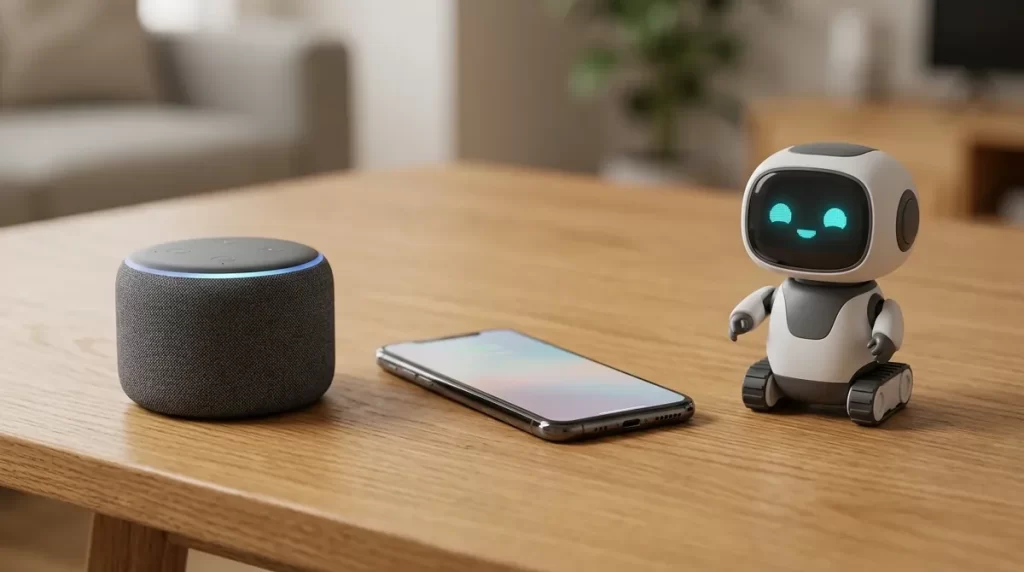
Robot companion vs chatbot, smart speaker and service robot
The categories overlap. A companion can answer questions like a smart speaker, a telepresence robot may be socially valuable, and a utility robot can have a friendly voice. The primary purpose and physical embodiment provide the clearest distinction.
| Technology | Physical body | Main purpose | Typical interaction | Key limitation |
|---|---|---|---|---|
| Robot companion | Yes | Social engagement, support or shared routines | Voice, movement, touch, expression and personalization | Capabilities are product-specific and often cloud-dependent |
| AI companion app | No; phone or computer interface | Conversation or role-play | Text, voice and generated media | No independent physical presence; emotional-safety concerns still apply |
| Smart speaker | Stationary device | Information and home control | Voice commands and brief responses | Usually reactive and task-oriented rather than relational |
| Utility robot | Yes | Cleaning, delivery, inspection or another task | Controls, schedules and status alerts | Social behavior is secondary even if the interface is friendly |
| Telepresence robot | Usually mobile | Extend a remote person’s sight, voice and movement | Video call controlled by a human | The relationship is primarily between people, not with the robot |
| Medical robot | Yes | Diagnose, monitor, treat or rehabilitate under a medical purpose | Clinical workflow | Requires evidence, regulation and professional accountability appropriate to its use |
How does a robot companion work?
Every interaction passes through a chain. The product’s quality depends on the weakest link, which may be a noisy microphone, uncertain recognition, slow cloud response or limited motor control.
-
SenseMicrophones, cameras, touch sensors, buttons, distance sensors or internal telemetry capture an event.
-
InterpretSoftware estimates speech, identity, objects, position, touch or intent. An estimate can be wrong.
-
DecideRules, behavior systems or AI models select a response within product permissions and safety limits.
-
ActThe robot speaks, moves, changes expression, displays content, sends a notification or does nothing.
-
UpdateSelected preferences, events or summaries may affect later interactions locally or through a cloud profile.
Not every robot uses generative AI, and generative conversation does not control the entire machine by itself. Physical actions usually pass through more constrained software because an incorrect motor command has different consequences from an incorrect sentence. Our guide to how AI companion robots work explains sensors, behavior architecture, memory and cloud processing in detail.
Seven common types of robot companion
Robotic pets
Dog-, cat- or animal-inspired robots use movement, sound, touch and recurring behavior to create playful presence. Conversation may be limited.
Examples: Sony aibo, LOVOT and PARO occupy different points in this broad family.
Desktop companions
Small character robots live on a desk or table and emphasize animation, games, recognition and brief conversation.
Best fit: entertainment, collecting, coding or low-space interaction.
Social assistants
Voice-first or screen-based systems organize activities, reminders, information and proactive check-ins around a user’s routine.
Best fit: structured engagement when physical manipulation is unnecessary.
Therapeutic and care robots
These are designed or deployed within a defined care context. Evidence and supervision matter more than a friendly appearance.
Best fit: programs with a clear protocol and accountable human team.
Educational robots
Programmable companions can support coding, language activities, storytelling or guided practice.
Best fit: a learning objective with age-appropriate privacy and adult oversight.
Telepresence companions
A mobile camera and screen help a distant family member, colleague or clinician join the space.
Best fit: human-to-human connection across distance.
Assistive companions
Some robots combine social interaction with accessibility, monitoring, navigation or physical help.
Best fit: a documented access need after testing with the intended user.
These categories are not certifications. The same robot may be marketed for education, companionship and care, but evidence for one setting does not automatically establish effectiveness in another. See our guides to robot companion therapy and robots for people with disabilities for more careful use-case analysis.
What can robot companions do—and what can they not do?
Common real capabilities
- Respond to voice, touch, buttons or visual cues.
- Perform character animations and autonomous routines.
- Remember selected names, preferences or schedules.
- Provide games, stories, music, prompts or information.
- Support video calls, caregiver messages or app controls.
- Recognize people or objects under supported conditions.
- Receive software, content and behavior updates.
Claims that require caution
- Knowing a person’s true emotional state.
- Providing dependable medical or emergency judgment.
- Replacing human friendship, care or supervision.
- Understanding every accent, room or social situation.
- Remembering accurately without privacy tradeoffs.
- Operating indefinitely after cloud support ends.
- Feeling love, empathy, pain or consciousness.
The distinction is not meant to dismiss the experience. People can enjoy, value or feel attached to an artificial companion while understanding how it works. A realistic expectation makes disappointment and unsafe reliance less likely. Read the fuller analysis of robot companion benefits and limitations.
Who may benefit from a robot companion?
The best question is not “Who needs a robot friend?” It is “Which user, goal and environment fit this product’s tested capability?”
Adults seeking entertainment
A desktop character or robotic pet can provide novelty, routines and playful interaction without the responsibilities of a live animal.
Check recurring costs and whether novelty remains after the return period.
Older adults
Reminders, activities, family connection and proactive prompts may be useful when accessible and wanted by the person.
A robot should complement contact and care, not become a reason to reduce them.
Children and families
Robots can support play and coding when content, data collection and physical behavior are age-appropriate.
Use parental controls, shared spaces and clear time limits; do not assume a companion is a babysitter.
Disabled users
Voice, telepresence and automation can improve access when the controls match the individual’s body, communication and environment.
Test with the intended user and preserve an alternative when recognition fails.
Remote workers
Telepresence, focus routines or ambient interaction may reduce friction in distributed work.
Workplace recording and monitoring require transparent consent.
Care and education teams
A robot can deliver repeatable activities or extend a professional’s reach within a defined program.
Measure the intended outcome and document who intervenes when the system is wrong.
Evidence varies by product and outcome. Small trials, short sessions and high engagement do not prove a lasting health benefit. Our research and clinical-trials guide explains how to interpret study quality.
How much does a robot companion cost?
The category spans inexpensive toys and compact desktop robots through premium robotic pets and specialized care systems. Purchase price alone is a poor comparison because connected products can require subscriptions, proprietary repairs or replacement batteries.
Hardware and accessories
Robot, charging dock, optional clothing, sensors, controller, protective case or delivery fees.
Cloud and content
Required membership, AI features, cellular service, caregiver portal, storage or downloadable activities.
Maintenance and repair
Cleaning, batteries, worn motors, shipping to service, accidental damage and parts availability.
Cancellation and end of service
Data deletion, remaining offline functions, resale restrictions and whether the device works without the vendor.
For current product-level pricing, availability and required plans, use our best robot companions guide and Sony aibo, LOVOT, EMO and PARO comparison. Prices should always be confirmed on the seller’s checkout page.
How to choose a robot companion safely
-
Define the outcomeWrite one sentence describing the primary use. “Daily spoken reminders” is evaluable; “advanced AI friend” is not.
-
Separate required from optional featuresList mobility, languages, volume, touch, app compatibility, offline operation and accessibility requirements.
-
Verify the current productDistinguish shipping hardware from announced features, research demos, waitlists and future updates.
-
Test the real environmentCheck voice recognition, lighting, floor transitions, Wi-Fi, charging access, pets, stairs and the intended user’s comfort.
-
Review data and permissionsIdentify cameras, microphones, recordings, cloud processors, face profiles, retention, advertising and account sharing.
-
Investigate the vendor lifecycleLook for warranty, repair location, security updates, subscription terms, export/delete controls and an end-of-service policy.
-
Preserve human alternativesNever make essential care, safety or emotional support depend entirely on one connected product.
For a deeper risk framework, read our guide to privacy, consent, security and emotional safety. The U.S. Federal Trade Commission’s 2025 inquiry into AI chatbots acting as companions also illustrates why disclosures, monetized engagement, child safety and use of intimate conversation data deserve scrutiny. Although that inquiry concerns chatbots, physical companions can raise related issues when they use conversational AI.
Where did companion robots come from, and where are they going?
Modern products combine several traditions: scripted conversation, expressive social-robotics research, autonomous robotic pets, therapeutic devices and cloud-connected assistants. Progress has not been a straight march toward humanoids. Specialized designs have often been more practical because they can optimize for touch, conversation, mobility or a care protocol.
Our history of robot companion technology traces ELIZA, Kismet, AIBO, PARO, Pepper, LOVOT and ElliQ. The future of robot companions guide evaluates on-device AI, embodied reasoning, regulation and realistic 2026–2035 scenarios without presenting science fiction as a release calendar.
Frequently asked questions
Is a robot companion the same as an AI companion?
No. An AI companion may be only an app or chatbot. A robot companion has a physical embodiment and uses some combination of sensors, sound, movement, touch or displays in the shared environment.
Do robot companions have feelings?
There is no established evidence that current commercial robots experience subjective emotion. They can recognize patterns, select emotional expressions and produce convincing language without feeling what they display.
Can a robot companion help with loneliness?
Some users report enjoyment, engagement or comfort, and some studies find promising outcomes in defined settings. Results vary, evidence has limitations, and a robot should not be used to justify reducing human contact.
Are robot companions safe for children?
Safety depends on age, hardware, content, data practices and supervision. Review the intended age, small parts, movement, conversational boundaries, parental controls and whether recordings or profiles are stored.
Can a robot companion replace a pet?
It can provide interactive routines without feeding, allergies or live-animal care, but it does not reproduce a biological animal’s behavior or relationship. Choose based on the household’s needs rather than treating the two as equivalent.
Do companion robots need Wi-Fi?
Many do for setup, speech processing, updates, apps or core AI features. Others retain limited offline behavior. Ask for an exact offline feature list and what happens when the subscription or service ends.
Are companion robots medical devices?
Not automatically. A friendly robot used for wellbeing is not necessarily approved to diagnose or treat a condition. Medical-device status depends on intended use, claims and the applicable regulator.
What is the best first robot companion?
The best starting point matches one defined use, budget and tolerance for subscriptions. A less expensive desktop robot may be appropriate for entertainment; a care or accessibility need requires much more specific evaluation.
Sources and editorial policy
Definitions and safety framing draw on the International Federation of Robotics’ service-robot overview, ISO 8373 robotics vocabulary, ISO 13482 personal-care robot safety requirements, the NIST AI Risk Management Framework and official consumer-protection material linked above.
Last reviewed: July 13, 2026. We update this guide when category definitions, major product capabilities, standards or consumer-safety guidance change materially.